
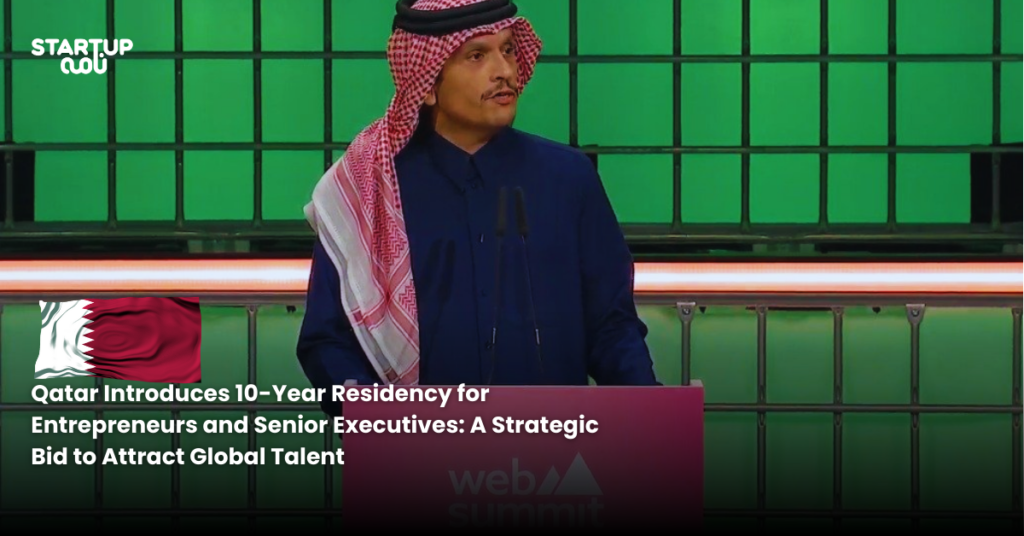
In early February 2026, Qatar unveiled a significant policy shift designed to strengthen its position as a global business and innovation hub: a 10-year residency programme tailored for entrepreneurs, founders, investors, and senior executives. The announcement was made by Prime Minister and Minister of Foreign Affairs HE Sheikh Mohammed bin Abdulrahman bin Jassim Al Thani during the opening of Web Summit Qatar 2026, one of the region’s largest technology and startup events.
This new long-term residency pathway forms part of Qatar’s broader strategy to diversify its economy, attract international expertise, and deepen its startup and innovation ecosystem.
What the 10-Year Residency Programme Is and Who It’s For
Under the programme, eligible individuals: entrepreneurs, founders, senior executives, and certain high-impact investors will be able to secure residency in Qatar for up to 10 years, which is one of the longest terms offered globally for non-citizens in the region.
This mark differs significantly from more traditional short-term work permits or yearly renewals that are standard across much of the Gulf region.
Key target groups include:
- Entrepreneurs and founders looking to establish or scale businesses in Qatar
- Senior executives and global business leaders with significant experience
- Strategic investors backing high-growth ventures
The initiative aims to provide predictability, stability, and continuity for international talent and business leaders who choose Qatar as a base of operations.
Why This Matters and Strategic Objectives
1. Attract and Retain Global Talent
By offering a decade-long residency, Qatar is signaling that it wants to compete with its Gulf neighbours, particularly the UAE, which has pursued various long-term visa schemes such as Golden Visas and other residency pathways and Saudi Arabia’s Premium Residency initiatives.
Long-term residency removes the uncertainty of frequently renewing work permits, encouraging founders and executives to build deep roots, invest in teams, and contribute to local economic growth over the long haul.
2. Power Economic Diversification
Qatar’s economy has historically been driven by hydrocarbon exports, particularly liquified natural gas (LNG). In recent years, the government has consistently pursued diversification into technology, innovation, financial services, tourism, and entrepreneurship. The expanded residency framework complements several existing and new incentives, including:
- Expansion of the Qatar Investment Authority’s “Fund of Funds”, which increased its venture capital allocation by $2 billion building on an earlier $1 billion initiative aimed at attracting global VC firms to Doha.
- Scaling of startup support programmes via Qatar Development Bank and Startup Qatar.
Together, these reforms help position Qatar as a hub for innovation, not just energy exports.
3. Support Startup and Innovation Growth
In practical terms, the new residency structure is designed to make Qatar more attractive for entrepreneurs and executives — from those building early-stage startups to senior leaders of multinational companies. This could have several ecosystem impacts:
- Faster company formation and registration: Web Summit organisers noted that founders could complete company setup and obtain residency in a matter of days during the summit.
- Easier access to talent: long-term visas make it simpler to hire and retain skilled workers from around the world.
- Stronger founder networks: with residency stability, founders are more likely to relocate or expand operations from overseas.
How the New Pathway Integrates With Qatar’s Existing Residency Landscape
Before the 10-year scheme, Qatar already offered other long-term residency options through incubator-endorsed entrepreneur visas and executive pathways. For example:
- The Entrepreneur Residency programme provides multi-year status to founders endorsed by local incubators such as Qatar Development Bank and Qatar Science & Technology Park (QSTP), along with benefits like family sponsorship and access to startup support services.
- The Executive Residency pathway allows eligible C-suite professionals already in Qatar to transition to long-term status under employer nomination.
The newly introduced 10-year plan builds on these existing systems, expanding the term and scope for global founders and leaders.
Regional Context: Gulf Competition for Talent
This shift aligns with a broader Gulf trend toward long-term residency and investor-friendly immigration policies:
- The UAE Golden Visa programme provides multi-year residency for investors, entrepreneurs, professionals, and exceptional talent. Some categories even offer lifetime visas in certain cases.
- Saudi Arabia’s Premium Residency (introduced earlier) allows residents to live, work, and invest without a local sponsor under several tracks including entrepreneur and investor categories.
- Oman launched a 10-year Golden Residency scheme for foreign investors in late 2025, with set investment thresholds enabling long-term stays and family sponsorship.
Qatar’s version, notably targeted at founders, investors, and executives emphasizes talent attraction and ecosystem building, rather than real estate investment or permanent settlement alone.
Potential Impacts on Business and Innovation in Qatar
Ecosystem Growth & Startup Attraction
Experts say long-term residency can reduce friction for international founders who might otherwise hesitate to relocate to a new market due to visa instability. Sustained residency promotes:
- Founder relocation and co-founder partnerships
- Regional headquarters or R&D centres
- Expansion of cross-border venture partnerships
Programs like Startup Qatar and streamlined incorporation processes position the country to attract more early-stage companies and follow-on funding.
Capital Flows and Investment
The expansion of the Qatar Investment Authority’s venture capital funds signals increased institutional interest in startup financing, which combined with talent attraction, can accelerate capital formation within Qatar’s borders.
Quality of Life and Community Building
Offering 10-year residency, especially with options to sponsor family members and access to local services, makes Qatar a more attractive lifestyle destination for global professionals and entrepreneurs seeking stability in the Gulf region.
A Strategic Move Toward a Global Innovation Hub
Qatar’s 10-year residency announcement represents a strategic leap in immigration and economic policy – not simply a visa extension. It reflects a deliberate repositioning of the country as a destination for global talent, innovation, and business leadership.
By combining long-term residency, VC incentives, streamlined business setup, and ecosystem support, Qatar is aligning policy with the needs of founders and executives in an increasingly competitive global market.
This policy is likely to boost foreign direct investment, entrepreneurial relocation, and long-term ecosystem growth, further diversifying Qatar’s economy and fostering connections with global innovation networks.
You may also like
-
MENA, Pakistan & GCC Tech Mid-Week Update
-
Canva Sets Up Regional HQ in Dubai, Pledges to Support 250,000 SMEs
-
MENA, Pakistan & GCC Tech Mid-Week Update
-
The Sharjah Entrepreneurship Festival: Where Visionaries, Founders, and Innovators Converge
-
Saudi Arabia’s VC Boom: H1 2025 Report Shows Record Funding, Rising Global Interest & a Maturing Ecosystem