
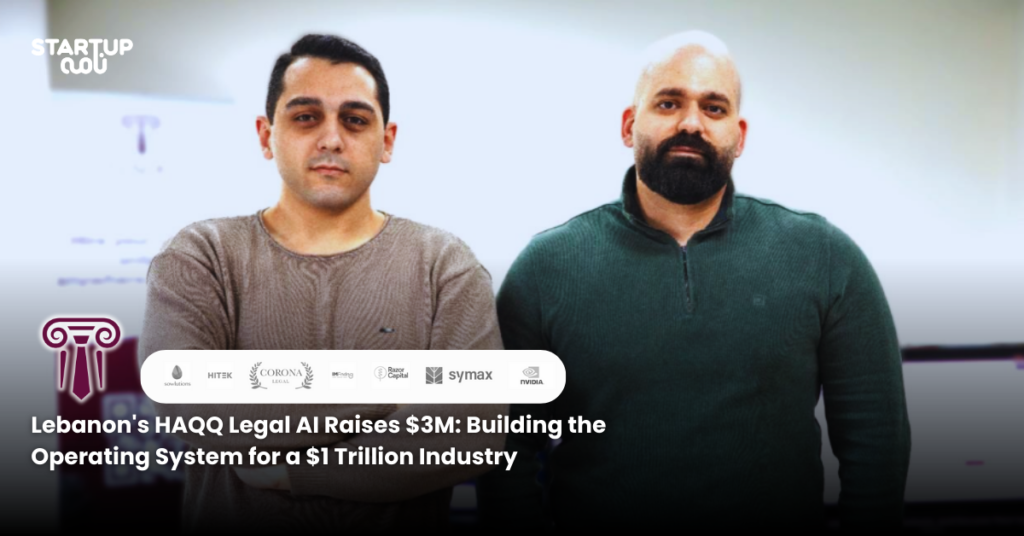
When you think of legal tech innovation, Lebanon probably isn’t the first place that comes to mind. Yet that’s exactly where HAQQ Legal AI is quietly building something remarkable: an AI-powered operating system designed to modernize how lawyers, law firms, and legal institutions work.
The Beirut-based startup just announced it has raised $3 million in total funding to date, led by Sowlutions Ventures with participation from HITEK Ventures, Corona Legal, IM FNDNG, Highworth, Razor Capital, SYMAX, Hamady Trust, and other strategic partners. More impressively, HAQQ is already cashflow positive with 1,900+ paying firms and over 7,000 clients across the region.
In a market where most AI startups are still figuring out product-market fit, HAQQ has quietly achieved what many consider the holy grail: real revenue, real customers, and real traction in one of the world’s most traditional industries.
The Problem: A $1 Trillion Industry Running on Fax Machines
The global legal services market is worth over $1 trillion. Yet for all that economic value, the industry remains stubbornly resistant to digital transformation. Many law firms still rely on faxes, scattered PDFs, fragmented software tools, and manual processes that haven’t changed much in decades.
For HAQQ’s co-founder and CEO Antoine Kanaan, this wasn’t just an abstract problem. It started with hundreds of people calling him, not because he was a lawyer, but because the legal system itself was failing them with outdated communication methods and disconnected tools. That friction became the catalyst for building something different.
“It started with a problem,” Kanaan recalls. “The legal system was failing people with faxes, PDFs, and scattered communication.” What began as frustration evolved into a vision: what if you could build a single platform that actually understood how lawyers work?
Not Just Another Legal Chatbot
Here’s where HAQQ gets interesting. While many AI companies are building generic chatbots or simple document review tools, HAQQ took a fundamentally different approach. They built what they call a “vertically integrated Legal AI operating system.”
Think of it less like ChatGPT for lawyers and more like the entire Microsoft Office suite plus Salesforce plus billing software, all powered by AI that actually understands your specific firm’s way of working.
The platform combines:
- AI-native legal intelligence for drafting and research
- Complete practice management (cases, clients, calendars)
- Financial workflows and billing
- Document management and storage
- Client relationship management (CRM)
- Payments and invoicing
- Institutional infrastructure for courts and regulators
All in one place. All designed to talk to each other. All learning from how your specific firm works.
Meet Justinian: Your Firm’s Digital Twin
At the heart of HAQQ sits Justinian, the company’s proprietary Legal AI engine. Named after the Byzantine emperor who codified Roman law, Justinian is designed to produce client-ready legal work from a single prompt.
But here’s what makes it different from generic AI tools: Justinian creates what HAQQ calls a “digital twin” of your law firm. It learns your templates, your writing style, your workflows, your jurisdictional requirements, and your firm-specific preferences. The more you use it, the more it understands how you work.
“Once a user hits their third prompt, they reorganize their day around HAQQ,” Kanaan explains. “It stops being an AI feature. It becomes the workspace.”
This isn’t AI that gives you generic outputs you need to heavily edit. It’s AI trained on your firm’s actual data, producing work that sounds like it came from your team because it learned from your team.
According to HAQQ’s internal benchmarks and real-world deployments, Justinian consistently outperforms general-purpose AI models on accuracy, structure, and jurisdictional reliability. It functions less like a research assistant and more like an AI lawyer capable of executing complex legal tasks with speed and consistency.
Built for the Real World: Security, Compliance, and Trust
AI in law isn’t just about being smart. It needs to be trustworthy, secure, and compliant with stringent data protection requirements. HAQQ built this into its foundation from day one.
The platform complies with:
- GDPR (European data protection)
- PDPL (Middle Eastern Private Data Protection Laws)
- ISO 27001 (information security)
- SOC 2 (data handling controls)
- ISO 42001 (AI governance framework)
More importantly, HAQQ offers local data hosting, giving law firms full control over where their sensitive client information lives. This is crucial for firms operating across multiple jurisdictions with different regulatory requirements.
“Security isn’t a checkbox,” Kanaan emphasizes. “It’s our moat. We built the architecture so every action is explainable, traceable, and compliant from the start.”
Every AI interaction is logged and auditable. Final legal decisions always stay with the lawyer. HAQQ proposes, you decide. This approach has helped the platform win trust from bar associations, courts, and public institutions who need more than just promises when it comes to handling confidential legal work.
The Human Touch: Augmentation, Not Replacement
There’s a common fear that AI will replace lawyers. HAQQ’s co-founder and Chief Legal Officer, Maître Abbas Kabalan, has a different vision.
“HAQQ is not about replacing human judgment. It’s about strengthening it,” Kabalan explains. “We use AI to take the repetitive, heavy work off lawyers’ shoulders so they can spend more time on what really matters: clear thinking, better decision-making, advocating for clients, and building real human relationships.”
The philosophy is simple: automation should replace chores, not judgment. The tedious work of drafting standard contracts, reviewing similar documents, tracking deadlines, and organizing case files can be handled by AI. The strategic thinking, client relationships, courtroom advocacy, and creative problem-solving? That stays human.
“The goal isn’t to turn lawyers into machines,” Kabalan adds. “It’s to give them better tools so they can be more present, more strategic, and more human in the way they practice law.”
By HAQQ’s calculations, consolidating fragmented tools into their unified platform saves firms up to $25,000 per lawyer per year. For small firms, that’s the difference between survival and growth. For larger practices, it’s the capital to scale.
Traction That Speaks Volumes
The numbers tell a compelling story:
- 7,000+ total clients across enterprises, law firms, bar associations, courts, and public institutions
- 1,900+ paying law firms (not just users, actual paying customers)
- Already cashflow positive (achieved profitability before raising major funding)
- Operating in Lebanon, Egypt, and Jordan with expansion plans across MENA
- Strategic partnerships with national bar associations for top-down market access
- Member of NVIDIA Inception Alliance Program for AI infrastructure support
This kind of traction is rare for any startup, let alone one based in Lebanon during one of the country’s most challenging economic periods.
HAQQ’s business model offers a forever-free tier for solo lawyers, making the platform accessible to individual practitioners. For firms ready to scale, pricing is customized based on size and needs. This freemium approach has helped drive adoption while proving the platform’s value before asking firms to commit financially.
The Lebanese Resilience Factor
It’s worth pausing to appreciate what HAQQ has built despite, or perhaps because of, its challenging operating environment. Lebanon has faced severe economic crisis, political instability, and infrastructure challenges over the past several years. Yet somehow, HAQQ not only survived but thrived.
This speaks to a broader trend: some of the most innovative solutions come from markets where legacy systems never took hold in the first place. Without decades of entrenched legal software to compete with, HAQQ could build from scratch, designing for the future rather than retrofitting the past.
“We’re building the AI Operating System for Law, starting with emerging markets where legacy systems never took hold and legal infrastructure is being rebuilt from scratch,” Kanaan notes.
The company’s success also highlights the depth of technical talent in Lebanon and the broader MENA region. Despite challenges, the region continues producing world-class engineers and entrepreneurs capable of competing globally.
What The Money Will Fund
The $3 million in funding will be deployed strategically across several key areas:
Deepening AI capabilities: Enhancing the Justinian engine and expanding agent architecture to handle more complex legal workflows and reasoning tasks.
Geographic expansion: Scaling operations across MENA and select global markets beyond the current Egypt and Jordan presence.
Security infrastructure: Further hardening security, compliance, and data residency foundations to meet enterprise and institutional requirements.
Team growth: Scaling engineering, product, and go-to-market teams to operate a system of record for legal work at global scale.
Enterprise deployments: Expanding institutional partnerships with courts, regulators, and large enterprises requiring legal infrastructure.
Notably, HAQQ is also working with banks and ministries to embed a fintech layer that digitizes legal payments. This could unlock financial visibility across a sector that has historically operated with limited transaction transparency, creating new data advantages and revenue streams.
The Bigger Picture: Vertical AI vs. Horizontal Wrappers
HAQQ’s approach represents an important lesson for AI startups generally: the difference between building wrappers around general AI models versus owning the full vertical stack.
Many legal AI startups simply took ChatGPT or Claude, added a legal-focused prompt, and called it a product. These “horizontal wrappers” are easily replicable and offer limited defensibility. Anyone with API access can build something similar.
HAQQ took the harder path: building a complete operating system that owns the data, workflows, distribution, and user relationship. The AI is just one layer in a comprehensive stack that includes practice management, billing, client relations, and institutional infrastructure.
“We believe the next generation of AI winners won’t just build wrappers, they’ll own the vertical stack, the distribution, and the data,” the founders explain on the company’s Crunchbase profile. “HAQQ is exactly that: a compound AI asset with infrastructure-level stickiness.”
This creates real defensibility. The more a firm uses HAQQ, the better its digital twin becomes. Switching costs increase over time because the platform becomes more valuable the longer you use it. HAQQ isn’t just software you subscribe to; it’s infrastructure you build your practice around.
Competing in a Crowded Market
HAQQ isn’t alone in pursuing legal AI. The space has attracted significant attention and capital:
Harvey AI, a US-based legal AI platform, recently raised funding at an $8 billion valuation and surpassed $100 million in annual recurring revenue. Major law firms and Fortune 500 companies use Harvey for document review, legal research, and workflow automation.
Clio, a legal practice management platform, is valued at $3 billion. Ironclad, focused on contract lifecycle management, was valued at $3.2 billion in its 2022 Series E.
Yet HAQQ’s focus on emerging markets and institutional infrastructure gives it a different competitive position. While Harvey targets top-tier US and European law firms, HAQQ is embedding itself into the legal systems of countries rebuilding their legal infrastructure from scratch.
The company’s partnerships with national bar associations provide distribution advantages that pure B2B sales can’t match. When the bar association in a country endorses and distributes your platform, you’re not just another vendor. You become part of the official legal infrastructure.
What This Means for MENA’s Legal Tech Ecosystem
HAQQ’s success has implications beyond one company’s growth trajectory. It demonstrates that MENA-based startups can build genuinely innovative products in highly regulated, traditional industries and achieve real commercial traction.
The legal industry is notoriously difficult to disrupt. Lawyers are risk-averse by training. Regulatory requirements are complex. Data security is paramount. Switching costs from existing tools are high. Yet HAQQ found a way through by focusing on real problems, building comprehensive solutions, and earning trust through compliance and performance.
For other founders in the region, HAQQ offers a playbook: identify infrastructure gaps in traditional industries, build vertically integrated solutions rather than point tools, achieve profitability before raising big rounds, and leverage regional dynamics (like rebuilding legal systems) as competitive advantages rather than obstacles.
The company’s ability to raise funding despite operating from Lebanon also sends an important signal to investors: great companies can emerge from anywhere if they’re solving real problems with defensible technology.
The Road Ahead
Looking forward, HAQQ faces both opportunities and challenges as it scales.
On the opportunity side, the global legal market is massive and still largely undigitized. HAQQ’s institutional partnerships could accelerate adoption in ways pure B2B sales never could. The fintech layer they’re building could unlock entirely new revenue models around legal payments and financial data.
The challenges are real too. Competing with well-funded US rivals will require continued product innovation and customer retention. Scaling across different jurisdictions means navigating varying legal frameworks, languages, and regulatory requirements. Maintaining security and compliance standards as the platform grows will require constant vigilance.
Perhaps the biggest test will be whether HAQQ can maintain its product quality and customer intimacy while scaling rapidly. Many startups that grow too fast lose the deep understanding of customer needs that made them successful in the first place.
But if the founders’ confidence is any indication, they’re not worried. “Quite a lot of people wonder how we can be so confident about the future of Legal AI, and the answer is quite simple, really: we’re the ones building it,” Kanaan says.
“Legal AI is much more than just a chatbot. It’s ontological systems, security infrastructure, data mapping, context building, and predictive analytics. It’s not just about understanding jurisprudence. It’s about modeling real-world enterprise decision-making, workflows, and outcomes. This is what it really means to digitize justice.”
Final Thoughts
In an ecosystem often dominated by consumer apps and e-commerce platforms, HAQQ represents a different kind of startup: deep tech applied to institutional infrastructure, solving complex problems in traditional industries, building for profitability from the start.
Their story is proof that innovation doesn’t require perfect conditions. Sometimes the best solutions come from founders facing real problems in challenging environments, building tools they themselves need, and refusing to accept that “this is just how things are done.”
For solo lawyers in Cairo trying to manage their practice, for law firms in Amman handling cross-border cases, for courts in Beirut digitizing their operations, HAQQ isn’t just a better software tool. It’s infrastructure that didn’t exist before, making possible workflows that were previously too complex or expensive to implement.
That’s the kind of impact that matters: not just building another app, but creating foundational infrastructure that empowers an entire industry to work better.
As HAQQ continues scaling across MENA and beyond, they’re not just building a successful startup. They’re helping write the next chapter of how legal work gets done.
HAQQ Legal AI was founded in 2020 by Antoine Kanaan and Maître Abbas Kabalan. The platform currently serves over 7,000 clients across Lebanon, Egypt, and Jordan with expansion planned throughout MENA and select international markets.
You may also like
-
Anthropic’s New AI Jobs Report: Why the Middle East Should Pay Attention
-
Pakistani AI Startup Virtuans Gets Acquired by US Firm AutoAcquire in Seven-Figure Deal
-
Shorooq’s $200M QIA-Backed Fund: Solving MENA’s Missing Pre-IPO Engine
-
Qureos Secures $5 Million Seed Round to Transform Hiring with AI Across MENA and Beyond
-
MENA, Pakistan & GCC Tech Mid-Week Update