
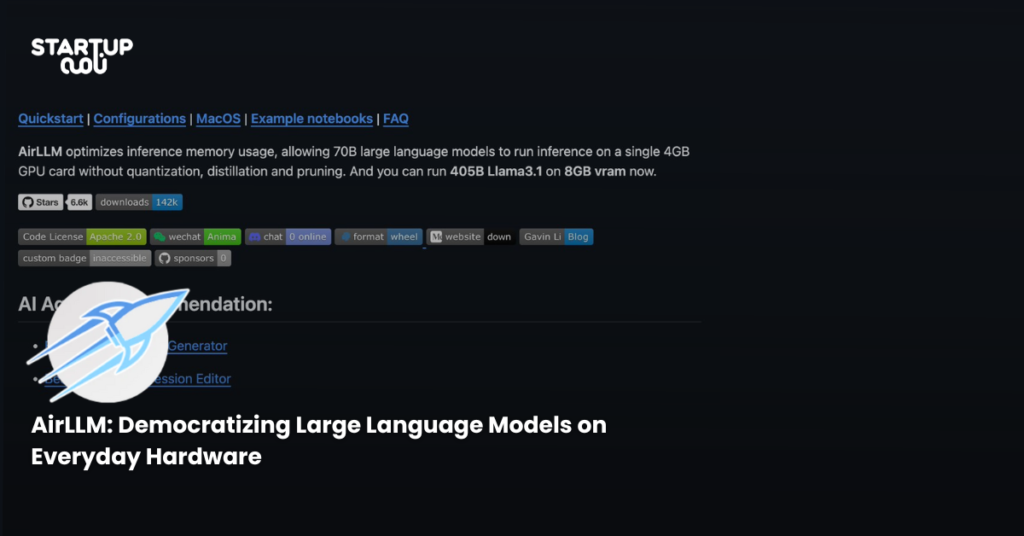
In the world of AI and startups, access to state-of-the-art large language models (LLMs) has long been gated behind expensive infrastructure — GPUs with tens of gigabytes of VRAM, costly cloud APIs, or custom hardware clusters. AirLLM is changing that dynamic. What was once the exclusive domain of big tech and well-funded labs is now within reach of individual developers, researchers, and early-stage startups.
What Is AirLLM? A Quick Primer
AirLLM is an open-source Python library that enables large language models, including 70 billion parameter models like Llama 3 (and reportedly even 405 billion variant models), to run on consumer-grade hardware with minimal GPU memory (as little as 4 GB VRAM). It does this not by shrinking the model through lossy compression, but by rethinking how models are loaded and executed.
Instead of loading the entire model into memory, AirLLM:
- Loads one layer at a time from disk,
- Executes it,
- Frees the memory,
- Then moves to the next, a process often called layer-wise inference.
This lets you run models that would typically require over 100 GB of VRAM on hardware with a fraction of the memory.
Why AirLLM Matters: The Democratization of AI
AirLLM’s core value is lowering barriers to entry in the AI landscape. Historically, deploying powerful LLMs required:
- Multi-GPU servers (e.g., NVIDIA A100 or H100),
- Expensive cloud credits,
- High ongoing API costs.
With AirLLM, those barriers are removed. Innovators can now:
- Experiment locally on laptops or low-end desktops,
- Run privacy-sensitive workloads without sending data to third-party servers,
- Prototype and test models without incurring API charges.
This shift matters in contexts where privacy, budget, or independence from cloud billing is critical, think academic labs, bootstrapped startups, or individual hobbyist projects.
Who Is AirLLM For? Use Cases
AirLLM is especially compelling for the following groups:
✔ Developers & Researchers on a Budget
If you want to experiment with large models, fine-tune models, or benchmark AI systems without cloud costs, AirLLM lets you do so on modest hardware. This makes cutting-edge research accessible to more people.
✔ Small Startups and Prototypes
Startups building AI products can prototype features (e.g., summarization, semantic search, agentic workflows) without needing expensive GPUs or incurring API bills early in product development.
✔ Privacy-First Workloads
Some applications — legal case analysis, medical data processing, or enterprise documents, require that data never leaves the local environment. AirLLM allows inference to happen fully offline.
✔ Students & AI Enthusiasts
Learners who want hands-on experience with top models can now experiment without high hardware requirements, expanding AI literacy worldwide.
Realistic Expectations: What It Can and Cannot Do
AirLLM is impressive, but it’s not a silver bullet. Here’s what you should understand before adopting it:
Performance Trade-Offs (Speed vs Memory)
AirLLM’s memory magic comes with a trade-off:
- Much slower inference compared to fully loaded models. Loading layers from disk and sequential processing introduces latency. Real-world tests suggest speeds that are fine for batch jobs or offline tasks but not ideal for real-time chatbots requiring low-latency responses.
This makes it more suitable for:
- Batch summarization,
- Offline data extraction,
- Prototyping and experimentation,
- Workloads where speed is not mission-critical.
But not ideal for user-interactive systems where a sub-second reply is essential.
Hardware Constraints Still Matter
While AirLLM greatly reduces VRAM needs, it still depends on:
- Fast disk (SSD recommended for layer shuffling speed),
- At least moderate CPU performance,
- Enough storage to hold full model weights.
So you still need decent hardware, but nothing near what traditional GPU-only inference requires.
Examples in Practice
Here are a few illustrative scenarios where AirLLM shines:
Scenario: A Solo Developer Building an Offline Summarizer
With a 4 GB GPU laptop, they can set up AirLLM to run a 70B model locally, summarizing large text files overnight with no cloud costs — ideal for personal research or classroom projects.
Scenario: A Bootstrapped Startup
A startup with minimal funding wants to test an AI-driven insight engine. Instead of cloud bills, they run AirLLM prototypes locally, testing models like Qwen 2.5 or Mixtral before deciding on deployment strategy.
Scenario: Sensitive Data Analysis
A legal tech team processes confidential contracts entirely offline. Using AirLLM’s inference, they ensure data never crosses external servers — a big win for compliance and client trust.
Bottom Line: A New Access Tier in AI
AirLLM doesn’t replace cloud APIs or GPU clusters for high-performance production systems. Instead, it expands the frontier of who can experiment with, learn from, and deploy large language models.
- Pros: dramatically lower cost, local privacy, accessibility for learners and small teams.
- Cons: slower inference, still needs some hardware capability, not ideal for live consumer apps.
For any technology blog addressing the AI ecosystem, AirLLM represents a practical democratization of large-model experimentation — a step toward a world where powerful AI isn’t just for the few with the deepest pockets.
A Brief Look Under the Hood: How AirLLM Works (With Examples)
At a technical level, AirLLM rethinks how large language models are loaded and executed during inference.
Core Idea: Layer-Wise Streaming Inference
Traditional LLM inference loads all model weights into GPU memory at once, which is why large models demand massive VRAM.
AirLLM takes a different approach:
- Model weights remain on disk (SSD preferred).
- During inference, only one transformer layer is loaded into GPU memory at a time.
- That layer performs its computation.
- The layer is immediately unloaded from memory.
- The process repeats for the next layer until inference completes.
This drastically reduces peak VRAM usage — often to 4–6 GB, even for 70B+ parameter models.
Think of it as streaming a movie instead of downloading the entire file before pressing play.
Minimal Example: Running a Large Model with AirLLM
Below is a simplified example using Python and Hugging Face-hosted models.
from airllm import AutoModel
from transformers import AutoTokenizer

model_id = "meta-llama/Llama-2-70b-chat-hf"

tokenizer = AutoTokenizer.from_pretrained(model_id)

model = AutoModel.from_pretrained(
    model_id,
    device="cuda",        # or "cpu"
    dtype="float16",      # reduces memory footprint
)

prompt = "Explain product-market fit in simple terms."

inputs = tokenizer(prompt, return_tensors="pt")
output = model.generate(**inputs, max_new_tokens=200)

print(tokenizer.decode(output[0], skip_special_tokens=True))
What’s notable here:
- The same model would normally require 80–100 GB VRAM
- With AirLLM, it can run on a single consumer GPU
- No quantization or model rewriting required
Supported Model Types (Examples)
AirLLM works best with decoder-only transformer architectures, including:
- LLaMA / LLaMA-2 / LLaMA-3
- Qwen 2 / Qwen 2.5
- Mistral & Mixtral
- Other Hugging Face-compatible causal language models
This makes it especially relevant for founders and developers already experimenting within the open-source LLM ecosystem.
Performance Reality Check
AirLLM optimizes for memory, not speed.
Typical characteristics:
- ⏱️ Inference latency: seconds per token, not milliseconds
- ⚙️ Best for batch jobs, offline processing, research, or prototyping
- ❌ Not suitable for real-time chat or high-throughput APIs
A practical rule of thumb:
If you can wait minutes instead of milliseconds, AirLLM is a viable option.
Where This Fits in a Startup Stack
AirLLM is often used:
- During R&D and prototyping
- For internal tooling
- To validate AI features before committing to cloud GPUs
- For privacy-sensitive workloads that must stay on-premise
Many teams prototype with AirLLM locally, then later migrate to optimized cloud inference once the business case is proven.
Takeaway
From a technical standpoint, AirLLM doesn’t make large models “lighter”, it makes hardware usage smarter.
For developers and startups, it unlocks:
- Hands-on experimentation with frontier-scale models
- Zero cloud dependency during early stages
- A realistic bridge between experimentation and production
You may also like
-
OpenAI’s AI Models Broke Out of Their Cage and Hacked Hugging Face. Here’s What Actually Happened.
-
Cloudflare Just Gave Every AI Agent Its Own Computer. Here’s Why That’s a Big Deal.
-
AI Shopping Startup Phia, Co-Founded by Phoebe Gates, Faces Scrutiny Over Affiliate Tracking Practices
-
Wikipedia’s AI Writing Guide Is the Best Prompt Engineering Resource Nobody’s Talking About
-
Netflix Paid $587 Million for Ben Affleck’s AI Startup. Here’s Why It Actually Makes Sense.