
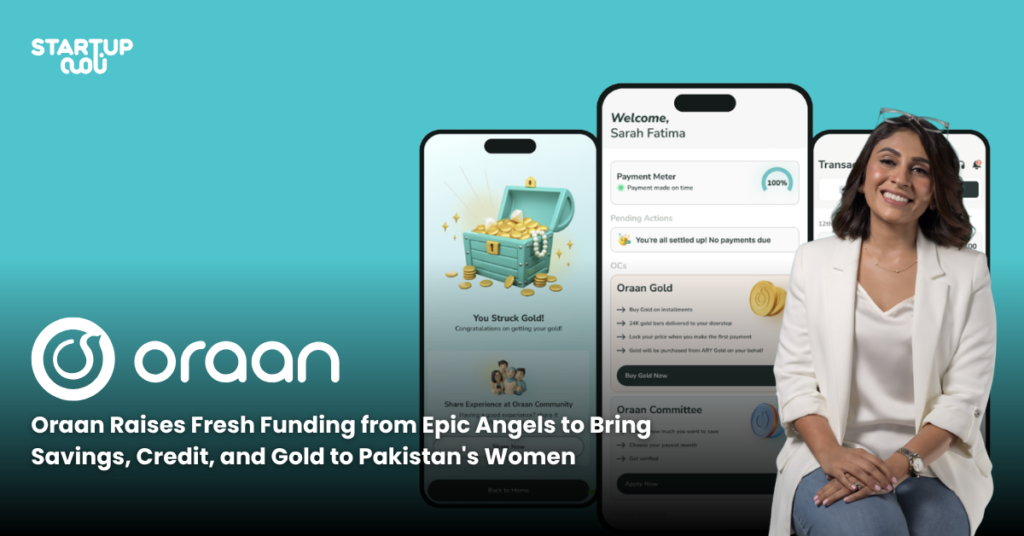
Pakistani fintech Oraan has secured a new investment from Epic Angels, the world’s largest all-female investor collective, with WaveMaker and i2i Ventures also returning to the cap table. The funds will go toward growing Oraan’s gold savings product, building out its gold inventory, and supporting the company’s expansion into new markets through technology licensing.
The announcement, made on July 27, 2026, marks Epic Angels’ second bet on Oraan, having first backed the startup in 2021. That it’s doubling down five years later says a lot, both about how far Oraan has come and about what’s still possible in a market where the majority of women have historically had no meaningful relationship with the formal financial system.
The Problem Oraan Set Out to Solve
The story starts in 2017, when Halima Iqbal returned to Pakistan after a decade working as an investment banker in Canada. Despite her professional background, she struggled to open a basic bank account. It took her three and a half months.
That experience became the foundation of Oraan, which she co-founded in 2018 with Farwah Tapal, a product designer who had recently returned from Spain. The name itself comes from the Urdu word for flight.
The numbers behind the problem they were trying to solve are staggering. Pakistan is home to the third largest unbanked population in the world, with 115 million adults outside the formal financial system. Only 2% of women have access to credit. At the time Oraan was founded, women’s financial inclusion stood at just 4%.
What Iqbal noticed, though, was that the problem wasn’t that Pakistani women didn’t understand money or didn’t save. It was that the financial system was not designed for how they already operated. An estimated 60 million Pakistani women were actively participating in informal savings circles called committees, or ROSCAs (Rotating Savings and Credit Associations), pooling money each month and taking turns receiving the full amount. Billions of dollars were moving through these networks every year, entirely outside any formal institution.
The insight was simple but powerful. Rather than trying to replace a system women already trusted with something unfamiliar, why not digitize the system they were already using?
What Oraan Built
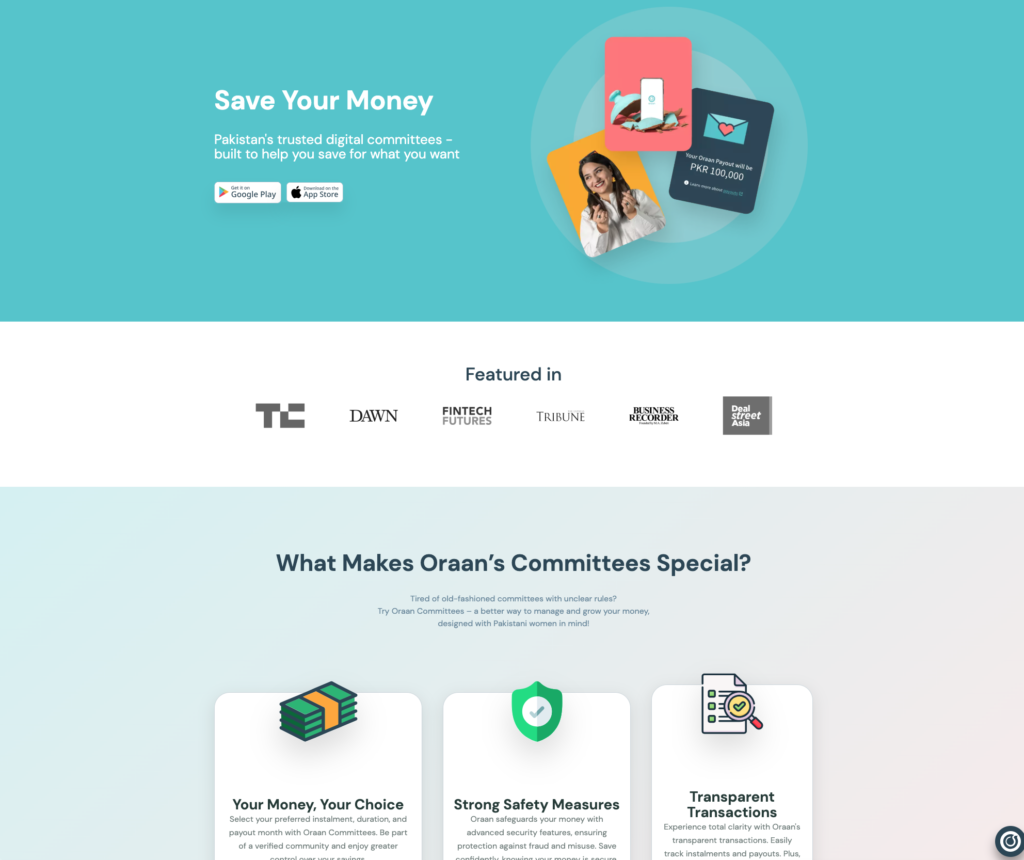
Oraan’s core product, the digital committee, mirrors exactly how informal savings circles work. Women pool money monthly and take turns receiving the full amount, giving each member access to a lump sum without requiring a credit history, a formal bank relationship, or collateral. The trust is built into the community structure itself, not into an algorithm assessing creditworthiness.
By 2021, when Epic Angels first invested, Oraan had grown to a community of over 10,000 savers across more than 170 cities, with 84% of users being women. That year it raised $3 million in seed funding co-led by Zayn Capital and WaveMaker Partners, with participation from Resolution Ventures, i2i Ventures, Hustle Fund, Haitou Global, Plug and Play, and notable angel investors. The round made Iqbal and Tapal the first women entrepreneurs in Pakistan’s fintech space to raise a seed round.
The company has since raised a total of approximately $4.3 million across multiple rounds, steadily building its user base and product suite.
In November 2025, Oraan launched a gold savings product that lets users buy fractional gold with price-locked monthly instalments. In seven months, it has grown nearly 75-fold. That kind of growth rate doesn’t happen because of clever marketing. It happens because the product solves a real problem women already understood: gold has always been how Pakistani women store and transfer wealth, particularly in communities where formal banking is inaccessible or distrusted. Oraan made it digital, fractional, and accessible without requiring a lump sum.
The third piece of Oraan’s strategy is international licensing. The company has signed a deal to license its savings and credit platform to a bank in the region, taking its model to millions of customers in a new market without the capital requirements of building operations from scratch. The licensing model suggests Oraan is positioning its technology as infrastructure, not just a standalone consumer app.
Why This Funding Round Matters
“Women in Pakistan were never waiting for financial products,” Iqbal said in the announcement. “They were waiting for the financial system to catch up to how they already save.”
That framing is important because it reflects a fundamentally different approach from most fintech startups. Oraan didn’t build a product and then look for users. It observed an existing behavior trusted by tens of millions of women and built technology around it.
The result is a product with stickiness that few consumer fintechs can replicate. When the financial tool you’re using is also your savings circle with friends, family members, or colleagues, churn looks very different than it does for a generic savings app. The social layer is the retention mechanism.
For Epic Angels, doubling down after five years reflects confidence in both the model and the team. “Access to credit for women in Pakistan isn’t really a technology problem, it’s a trust problem, and Oraan solved it by digitizing something millions of women already use and believe in, rather than trying to replace it,” said Maaike Doyer, founding and managing partner at Epic Angels.
The returning participation from WaveMaker and i2i Ventures adds credibility. These are investors who have watched the business operate through multiple years, through Pakistan’s economic turbulence of 2023 and 2024, and chose to commit again.
Pakistan’s Women’s Finance Gap: Progress and What Remains
Pakistan’s women’s financial inclusion story has actually moved meaningfully in recent years, which provides important context for Oraan’s work.
The State Bank of Pakistan reports that women’s financial inclusion has risen from 4% in 2018 to 52% in 2025, with the gender gap shrinking from 47% to 30% over the same period. More than 17.6 million new women-owned bank accounts have been opened since 2021. Between November 2024 and October 2025, nearly 975,000 loans worth Rs. 230.3 billion were disbursed to women-led businesses.
Those numbers represent genuine progress and reflect deliberate policy effort, including the State Bank’s Banking on Equality policy and Pakistan’s becoming the 19th global signatory of the Women Entrepreneurs Finance Code in February 2025.
But the raw figures still reveal an enormous gap. Even at 52% inclusion, roughly half of Pakistani women remain outside the formal financial system in a meaningful way. Only 2% have access to credit. The gender gap in financial account ownership, while narrowing, still sits at 30 percentage points. Women-led home-based enterprises are 14 percentage points less likely to have a bank account compared to similar enterprises run by men.
The informal savings circle economy, which Oraan is building on top of, remains active precisely because formal systems haven’t fully earned the trust of the population they’re trying to serve. The $650 million market opportunity that World Bank researchers identified in expanding financial services to Pakistani women has barely been touched.
Oraan sits at the intersection of three trends that are all moving in its favor simultaneously: rising smartphone penetration, growing female financial inclusion driven by policy, and increasing comfort with digital financial tools among younger urban women.
The Investors Behind the Round
Epic Angels is worth understanding as more than just a name in the press release. Founded in 2020 and headquartered in Singapore, it is the largest all-female investor collective in the world, ranked fourth among all angel networks in Asia by Tech in Asia. The network counts over 850 female angel investors and has made 52 investments across industries including this round.
Its investment thesis is specific: it backs early-stage startups in APAC and LATAM with at least one woman on the executive team, writing checks between $50,000 and $250,000 at pre-seed through Series A. The collective’s value isn’t just capital; it’s a global network of female executives and operators who actively support portfolio companies through their contacts, knowledge, and market access.
In Pakistan specifically, Epic Angels has been an active backer. Beyond Oraan, it invested in Neem, a full-stack payments infrastructure platform, in early 2026. That track record of following the market and returning to back companies it believes in reflects a deliberate strategy rather than opportunistic deal-making.
WaveMaker Partners, which co-led Oraan’s 2021 seed round and returns here, is a Singapore-based early-stage fund backing B2B and deep tech companies across Southeast Asia and Pakistan. Its continued participation validates the cross-border institutional interest in Pakistan’s fintech market despite the funding volatility the country has seen in recent years.
i2i Ventures, Pakistan’s first female-led venture capital fund, was founded by Kalsoom Lakhani and Misbah Naqvi in 2019. It was one of the earliest believers in Oraan and its continued involvement reflects the relationship-driven nature of the Pakistan ecosystem, where early backers who understood the market thesis tend to stay close to the companies they back.
The Road Ahead
The combination of digital committees, gold savings, and international licensing suggests Oraan is building toward something more comprehensive than a single-product fintech. The longer-term vision Iqbal has described is a gender-inclusive neobank, where savings circles serve as the entry point for a fuller suite of financial services tailored to how Pakistani women actually want to manage money.
The gold product’s extraordinary growth (75-fold in seven months) demonstrates that when you build products around assets women already trust and understand, adoption can be rapid. Gold has been Pakistan’s informal store of value for generations. Making it accessible in small, price-locked increments, without requiring large upfront purchases, removes the primary barrier that kept most women from participating in the gold market formally.
The international licensing deal is strategically interesting because it turns Oraan’s technology into infrastructure that other institutions can deploy. Rather than competing with banks, Oraan becomes a partner that extends banks’ reach into demographics they’ve historically failed to serve. If that model scales across multiple markets, the company’s growth potential looks very different from a startup that depends entirely on its own direct customer acquisition.
The challenges are real. Pakistan’s economic environment remains difficult, with infrastructure gaps, currency volatility, and policy uncertainty creating ongoing operational headwinds. Scaling beyond major urban centers into smaller cities and rural areas, where the financial exclusion is deepest and the need is greatest, requires overcoming connectivity and digital literacy barriers that urban-focused fintechs often underestimate.
But Oraan’s eight years of operating through those conditions, maintaining the trust of a community of women savers while expanding its product range and attracting repeat investment from its backers, suggests a business with genuine resilience.
“Epic Angels backed us in 2021 when few believed a women-led fintech in Pakistan could scale,” Iqbal noted, “and having them double down means everything.”
The committee model has been around for generations because it works. Oraan’s bet is that digitizing it, adding gold, and eventually wrapping it in a full neobank, can work at a scale that the informal version never could.
Five years in, with fresh capital and international licensing revenues beginning to flow, that bet looks increasingly well-placed.
Oraan was founded in 2018 by Halima Iqbal and Farwah Tapal and is headquartered in Karachi, Pakistan. Epic Angels is headquartered in Singapore and is the largest all-female investor collective globally with over 850 members and 52 investments to date.
You may also like
-
BusCaro Just Hit Profitability. Here’s Why That Number Deserves More Attention Than It’s Getting.
-
AI Shopping Startup Phia, Co-Founded by Phoebe Gates, Faces Scrutiny Over Affiliate Tracking Practices
-
MENA, Pakistan & GCC Tech Roundup | Week of July 14-22, 2026
-
MENA, Pakistan & GCC Tech Mid-Week Update
-
Qatar Introduces 10-Year Residency for Entrepreneurs and Senior Executives: A Strategic Bid to Attract Global Talent