
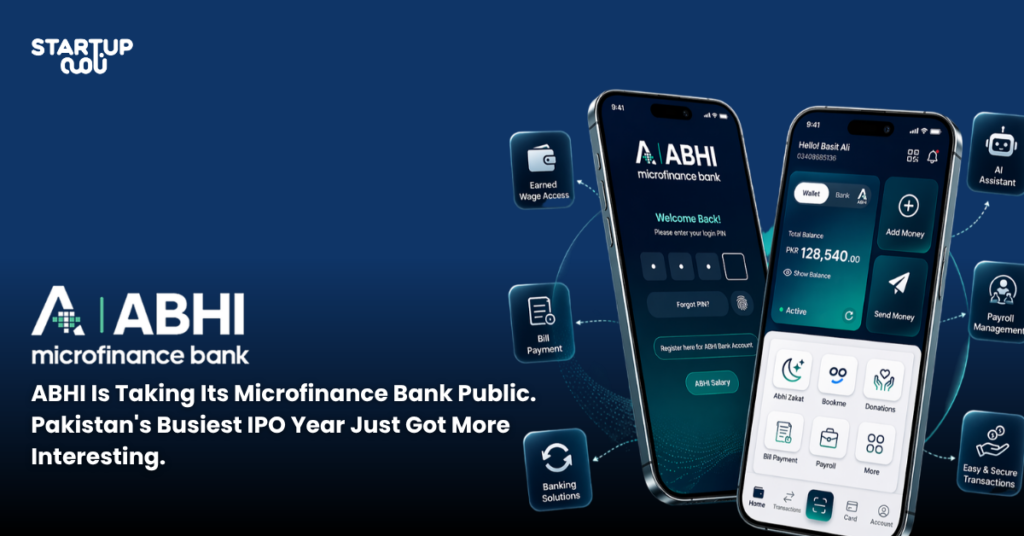
Pakistan’s fintech group ABHI is preparing to list its microfinance bank on the Pakistan Stock Exchange this month, becoming one of the most significant tech-led IPOs in the country’s history. The announcement, first reported by Bloomberg on July 30, 2026, marks a remarkable milestone for a company that started as a salary advance app just five years ago and has since transformed into a full-stack financial institution with ambitions that extend well beyond Pakistan.
ABHI Microfinance Bank plans to offer approximately 14% in new shares to raise between Rs. 2 billion and Rs. 3 billion ($7 million to $11 million). Arif Habib Limited, Topline Securities, and Growth Securities have been appointed as financial advisers. The bank held a roadshow in London and is targeting investors from Pakistan alongside frontier and emerging market funds.
From Earned Wages to a Bank: How ABHI Got Here
To understand the IPO, you need to trace the arc of how ABHI was built.
Omair Ansari and Ali Ladhubhai founded ABHI in 2021. Ansari came from Morgan Stanley, where he ran two emerging markets funds focused on consumer and fintech. Ladhubhai had a background in retail banking at HSBC and Samba Bank. Together, they identified a problem that anyone who has lived paycheck to paycheck understands immediately: your salary is accrued every day, but you can only access it once a month. In between, financial stress builds and expensive debt traps emerge.
ABHI’s answer was earned wage access (EWA): a platform that lets salaried employees draw down a portion of their accrued salary before payday, interest-free and Shariah compliant, with repayment automatically deducted at the next payroll cycle. The employer pays nothing. The employee avoids loan sharks, expensive credit cards, and the indignity of asking for salary advances through slow, bureaucratic HR processes.
The model found product-market fit quickly. ABHI went through Y Combinator’s Summer 2021 batch, one of the first Pakistani startups to do so, and raised a $2 million seed round led by Vostok Emerging Finance in June 2021. By April 2022, it had closed a $17 million Series A led by Speedinvest, with participation from Global Ventures, VentureSouq, Sturgeon Capital, FJ Labs, and RallyCap. Existing investors Sarmayacar, Fatima Gobi, and i2i Ventures also joined.
From there, ABHI moved fast. In 2023 it issued a $7.1 million Sukuk, becoming the first company in the MENAP region to issue Islamic bonds via this structure. It expanded into the UAE, Saudi Arabia, Bangladesh, and Oman. It grew its corporate client base to over 400 companies and its active employee user base to approximately 800,000, with customers including Unilever, Bank Alfalah, and Artistic Milliners. By 2022 it had reached a $90 million valuation. Total funding across all rounds has reached $58 million.
In October 2024, ABHI raised a further $15 million debt round led by Shorooq Partners, the Abu Dhabi-based multi-strategy firm, with Amplify Growth participating. That capital helped fund what came next: the acquisition of a bank.
The FINCA Acquisition: From App to Institution
In early 2024, ABHI and TPL Corp jointly announced a bid to acquire FINCA Microfinance Bank, one of Pakistan’s established microlenders. The acquisition completed in January 2025, with ABHI Pvt. taking approximately 75% ownership and TPL Corp holding the remaining stake.
The launch event in Karachi brought together international investors, industry leaders, and the State Bank of Pakistan Governor Jameel Ahmed, who called the partnership “a significant step toward strengthening Pakistan’s financial ecosystem and expanding access to credit for unserved and underserved communities.”
What happened next is the part that makes the IPO story compelling.
ABHI Microfinance Bank closed 2025 with a profit after tax of Rs. 1.019 billion, the highest in the bank’s history and a complete reversal from a loss after tax of Rs. 1.754 billion in 2024. According to Ansari, the bank had been losing up to $5 million annually before the acquisition. In its first full year under new ownership, it generated more than $3.5 million in profit. It is now on track to earn around $10 million this year.
That turnaround, from $5 million annual loss to $10 million projected profit in roughly 18 months, is what gives the IPO its credibility.
The operational changes that drove it were deliberate. ABHI digitized the bank’s operations, closed loss-making branches, integrated its earned wage access technology into the bank’s product suite through AbhiSalary, and applied an AI-powered credit scoring system that improved lending decisions. The result was a leaner, faster, more profitable institution with a tech-native approach to customer acquisition and credit risk.
What the IPO Will Fund
The proceeds from the listing will primarily strengthen the bank’s capital base, with its capital buffer expected to exceed the State Bank of Pakistan’s minimum regulatory requirement by next year.
But the forward roadmap is what’s most interesting. ABHI Microfinance Bank is explicitly targeting gold-backed lending as its next major product vertical. Ansari cited Muthoot Finance, India’s largest gold loan company with a market capitalization of over $10 billion, as the benchmark he’s watching. The comparison makes sense: Pakistan has an enormous informal gold economy, with households holding an estimated $70 billion worth of gold assets, most of it sitting as dead collateral with no way to unlock its value through formal credit channels.
The bank is also exploring a license to tokenize gold and is working toward building a crypto payments corridor for customers between Pakistan and the Middle East. Given ABHI’s significant presence in the UAE and Saudi Arabia, a cross-border payments product for the Pakistani diaspora would address a market that currently moves billions of dollars annually through informal channels.
These are not incremental product extensions. They represent an attempt to build Pakistan’s answer to what Nubank did in Brazil or what Kaspi.kz did in Kazakhstan: a fully digital, multi-product financial platform that captures a large share of everyday financial life for millions of people who were previously underserved by traditional institutions.
Ansari has explicitly cited both Nubank and Kaspi as the models he’s building toward. Nubank now serves over 100 million customers across Latin America with a market cap exceeding $50 billion. Kaspi became Kazakhstan’s dominant financial super app and listed on NASDAQ in 2024 at a valuation of around $18 billion. Both started in markets with similar characteristics to Pakistan: large populations, low formal financial inclusion, growing smartphone penetration, and dominant informal economies.
Pakistan’s IPO Moment
The timing of ABHI’s listing is not accidental. Pakistan is in the midst of its busiest IPO year on record.
In the first half of 2026, nine companies raised over Rs. 20 billion through public offerings on the Pakistan Stock Exchange, continuing momentum from 2025’s record activity. The PSX is up significantly from its lows, driven by IMF program stability, declining inflation, interest rate cuts by the State Bank (rates fell from 22% in June 2024 to 12% by mid-2025), and growing retail investor participation as Pakistanis shift savings away from fixed deposits toward equities.
Ten listings in 2026 have so far raised a record Rs. 19.8 billion. Post-listing performance has been strong across most new entrants, creating appetite among retail and institutional investors for new offerings. The window is open, and ABHI is moving through it.
For foreign investors, Pakistan’s stock market has been one of the best-performing in Asia over the past two years, recovering from a period of extreme stress during 2022-2023 when the country narrowly avoided a sovereign default. With IMF support in place, foreign exchange reserves rebuilding, and corporate earnings recovering, Pakistan’s equity market has attracted renewed interest from frontier and emerging market funds. The London roadshow signals ABHI’s intent to bring international institutional capital into the listing alongside domestic retail investors.
What Makes ABHI Different from Traditional Microfinance
Microfinance has a complicated reputation in Pakistan. The sector has historically relied on high-interest group lending to rural borrowers, with interest rates that critics argue trap borrowers in cycles of debt rather than helping them build financial resilience. ABHI’s approach is fundamentally different.
The earned wage access model is credit-free by design. Workers access money they have already earned, not borrowed money they need to repay with interest. The repayment happens automatically at payroll, eliminating the collection risk that drives high interest rates in traditional microfinance. There is no underwriting in the traditional sense because the wage accrual itself is the collateral.
The AI-powered credit scoring system ABHI built allows the bank to assess creditworthiness for more traditional loan products using non-traditional data: payroll records, transaction history, mobile usage patterns, and behavioral signals that are invisible to conventional credit bureaus. In a country where most people have no formal credit history, this approach unlocks lending for populations that conventional models simply cannot serve.
The branchless banking infrastructure, built on mobile-first technology, removes the cost structure that makes traditional microfinance branches expensive to operate. Lower operating costs translate into either lower interest rates for borrowers, higher margins for the bank, or both.
The Broader Ecosystem Signal
ABHI’s IPO carries implications beyond its own balance sheet.
Pakistan has produced very few technology company IPOs. The country’s startup ecosystem has raised less than $1 billion in total venture capital since 2015, and exit pathways for investors have historically been limited to private acquisitions or secondary sales. A technology-led financial institution listing on the PSX and attracting international institutional interest would establish a new precedent.
It validates a pathway that other Pakistani startups can point toward when raising capital: build, prove unit economics, acquire or build a licensed institution, demonstrate profitability, list publicly. That sequence is now real rather than theoretical.
It also signals continued confidence in Pakistan’s macro recovery. A company actively raising capital from international investors via a London roadshow, in a sector as regulated and dependent on macroeconomic stability as banking, is implicitly making a bet that Pakistan’s current trajectory continues. That confidence, from founders with as much information about ground realities as anyone, is a signal worth paying attention to.
For the fintech sector specifically, ABHI’s move toward banking licenses follows a pattern playing out globally: the most ambitious fintech companies eventually conclude that they need to become regulated financial institutions to fully realize their vision. Neobanks in Europe, digital banks in Southeast Asia, and challenger banks across Africa have all followed similar paths. ABHI is doing the same, just from a uniquely Pakistani starting point.
The Challenges Ahead
Turning a profitable microfinance bank into Pakistan’s Nubank is a different challenge from turning around a loss-making lender.
Scaling gold-backed lending requires physical infrastructure for gold assessment and storage that digital-first companies often underestimate. Regulatory approval for gold tokenization and crypto payment corridors in Pakistan’s still-cautious regulatory environment could take time. Competing with established commercial banks and mobile wallet providers for deposits and lending market share requires sustained investment in customer acquisition and product development.
The IPO itself introduces new obligations. Public company governance, quarterly reporting requirements, shareholder communication, and the scrutiny of a listed entity add operational complexity that private fintech companies don’t face. Managing growth expectations in a public market context while maintaining the agility needed to execute on ambitious product roadmaps is genuinely difficult.
And Pakistan’s macro environment, while improved, remains fragile. The IMF program provides stability but requires continued fiscal discipline. Currency volatility, while reduced, hasn’t disappeared. Political uncertainty remains a background risk. For a financial institution whose model depends on payroll integration with employers and stable monetary conditions, these macro risks are more directly relevant than they are for consumer internet companies.
Final Thoughts
ABHI’s microfinance bank IPO is the most significant milestone yet for a company that has moved faster and further than almost any Pakistani startup of its generation.
In five years, Omair Ansari and Ali Ladhubhai went from a salary advance app running on Y Combinator’s backing to a licensed bank generating $10 million in projected annual profit, preparing to list publicly while simultaneously pursuing gold lending, gold tokenization, and cross-border crypto payments.
The vision is explicit: build Pakistan’s Nubank. The foundation, a profitable bank, a large corporate client base, earned wage access technology, and proven ability to operate across multiple countries, is more substantial than most people outside Pakistan realize.
Whether ABHI can execute at the scale that comparison implies is the question the next five years will answer. But the IPO represents a genuine inflection point, the moment a Pakistani fintech moves from promising startup to public institution, with all the accountability, capital, and ambition that transition carries.
Pakistan’s startup ecosystem has been waiting for a story like this. It now has one.
ABHI was founded in 2021 by Omair Ansari and Ali Ladhubhai and is headquartered in Karachi, Pakistan. Abhi Microfinance Bank Limited plans to list on the Pakistan Stock Exchange in July 2026, offering 14% of shares to raise between Rs. 2 billion and Rs. 3 billion.
You may also like
-
MENA, Pakistan & GCC Roundup | August 5-27, 2026
-
MENA, Pakistan & GCC Tech Mid-Week Update Jul 28 – 5 Aug 2026
-
MENA, Pakistan & GCC Tech Roundup | Week of July 24-31, 2026
-
MENA, Pakistan & GCC Tech Roundup | Week of July 14-22, 2026
-
Uber’s $13.7 Billion Delivery Hero Takeover: What It Means for Talabat, HungerStation, and the MENA Region