
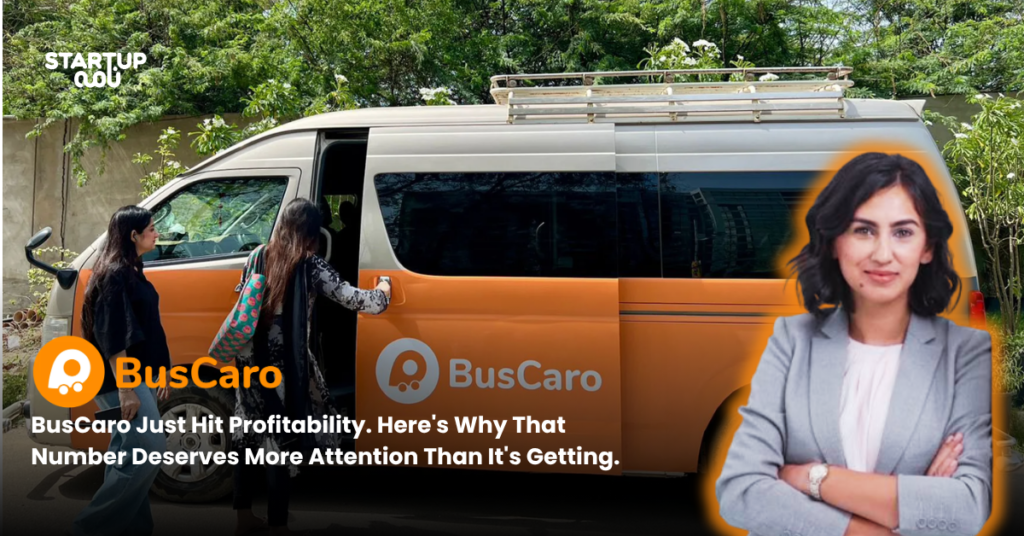
Pakistan’s bus-hailing startup reached positive EBITDA on $1.4 million in lifetime burn. In four years. In a market where three of its predecessors shut down before it launched.
In July 2022, Swvl announced it was pulling out of Pakistan. The next day, Maha Shahzad put BusCaro’s first bus on the road.
That timing wasn’t defiance for its own sake. Shahzad had been Swvl’s country head in Pakistan. She had watched Airlift collapse before Swvl did, watched Uber pull back, watched the mobility sector go from the hottest investment category in the country to something investors wouldn’t touch. She had also spent a decade working in Pakistan’s transport industry, at Foodpanda, Careem and then Swvl, and she understood something that the investors fleeing the sector did not fully account for: the problem hadn’t gone away. Thirty million commuters still needed to get to work and school every day. Women, who make up a significant portion of Pakistan’s urban workforce, still faced a transport system where nearly every survey of female public transit users finds close to 100% reporting sexual harassment. The demand for safe, reliable, affordable mass transit wasn’t going anywhere. The supply had simply collapsed.
So she started BusCaro out of her apartment in Karachi, with three people and one bus.
The Market No One Wanted to Fund
The timing was genuinely terrible by every conventional measure. The world was navigating post-pandemic disruption. Pakistan was reeling from catastrophic floods. Global VC was pulling back. And the specific sector Shahzad was entering had just produced two high-profile failures in rapid succession.
She received more than 400 rejections before securing her first meaningful capital, $160,000 in BusCaro’s first year of operations. That figure tends to get cited as a fundraising hardship story, which it is, but it also reflects something more structural: investors categorized BusCaro as a mobility startup in Pakistan, and the reference points for both of those things had just turned deeply negative.
What the rejections missed was that BusCaro wasn’t trying to be Airlift or Swvl. Both of those companies ran consumer-facing, app-first, on-demand models that required massive acquisition spend to generate transaction volume. BusCaro operates an asset-light model, partnering with vetted transport providers rather than owning its own fleet, and targets B2B and B2B2C customers, corporations, schools and institutions that pay for structured daily commute routes on behalf of their employees and students. The unit economics work differently. Retention is sticky because the customer relationship sits with the organization, not the individual commuter. Drivers earn more from filling a bus than from running individual rides. Passengers pay less than they would for a rickshaw or ride-hail.
Today the company processes around 40,000 bookings daily, 70% of riders are women and children, and BusCaro has maintained a 99.6% reliability rate with zero safety incidents. Those last two numbers are not incidental to the business. They are the business.
What the Profitability Number Actually Means
BusCaro recorded a positive EBITDA since April 2026, up from negative 9% between Pakistan’s fiscal year of July 2024 and June 2025. The company reached this milestone in less than four years of operations and with a reported lifetime burn of $1.4 million.
That last figure is the one worth pausing on. Annual revenue increased from $4.5 million to $6.5 million in its fourth year of operations, while annual recurring revenue reached $7.1 million.
To put $1.4 million in lifetime burn in context: Swvl raised $650 million across its lifetime and never reached sustainable profitability in any market. Airlift raised $120 million before shutting down. BusCaro reached positive EBITDA having raised a total of $3.5 million across all rounds combined. The capital efficiency gap between BusCaro and its predecessors is not a rounding error. It reflects a fundamentally different approach to building a mobility business in a capital-constrained market.
The $2 million round raised in September 2025 was structured as $1.2 million in new equity and an $800,000 debt facility, driven primarily by working capital needs, because BusCaro commits to paying its drivers on quick terms so they can continue to fuel their vehicles. This is the kind of operational detail that separates companies building sustainable unit economics from those chasing growth metrics. The debt facility funds the float between collecting from corporate clients and paying drivers. The equity funds expansion.
The Safety Infrastructure Behind the Numbers
BusCaro’s profitability story is also a safety infrastructure story, and separating the two misses the point of what the company is building.
85% of working women in Pakistan report experiencing sexual harassment at least once on public transport. That figure shapes every product decision BusCaro makes. The app includes a feature built specifically for women that lets them use a masked name instead of their real name when shown to drivers. The company is building an in-app SOS button that connects passengers directly with BusCaro and its safety partner. Routes are structured, not on-demand, which means drivers and passengers are matched in advance and monitored throughout the journey.
Roughly one-third of riders are women, one-third are minors, and one-third are men, each segment riding for different reasons. For women, the primary value is safety. For minors, it’s a school commute their parents can track in real time. For corporate clients, it’s predictable employee punctuality and reduced transport subsidy costs.
The company’s corporate client base includes Foodpanda, PepsiCo, Ibex and Indus Hospital among others, and corporate clients report reduced absenteeism, improved punctuality, and lower transport costs. That’s an ROI case that survives budget scrutiny, which is part of why BusCaro’s retention holds.
Where It Goes From Here
Looking ahead, Shahzad said the company is focused on launching new markets within Pakistan while laying the groundwork for international expansion, noting that rising fuel prices and expanding EV infrastructure are pushing more commuters toward shared transport.
The international expansion framing is deliberate. There are comparable models in the US, including Zum for children’s transportation and CharterUp for B2B charter, as well as Swvl’s current B2B focus in the Middle East and Volt in Turkey. BusCaro’s B2B2C model, adapted to Pakistan’s specific constraints around safety, pricing and route density, is portable to markets with similar gaps. South and Southeast Asia have several.
More than 30 million bookings have been made under BusCaro to date, 10 million more than was reported less than a year ago. That velocity, combined with positive EBITDA and recurring revenue at $7.1 million annually, gives the company something most Pakistani startups at this stage don’t have: the ability to negotiate the terms of its next funding round from a position of strength rather than urgency.
Sources: Zag Daily, Business Recorder, Dawn, Forbes, TechCrunch, Friday Times, BR Research
You may also like
-
Oraan Raises Fresh Funding from Epic Angels to Bring Savings, Credit, and Gold to Pakistan’s Women
-
AI Shopping Startup Phia, Co-Founded by Phoebe Gates, Faces Scrutiny Over Affiliate Tracking Practices
-
MENA, Pakistan & GCC Tech Roundup | Week of July 14-22, 2026
-
MENA, Pakistan & GCC Tech Mid-Week Update
-
Qatar Introduces 10-Year Residency for Entrepreneurs and Senior Executives: A Strategic Bid to Attract Global Talent