
Anthropic just released a landmark research report tracking how AI is actually affecting jobs, not how we think it might. Their findings carry particular weight for the Middle East, where governments have bet billions on AI leadership while workers show surprisingly high optimism about automation.
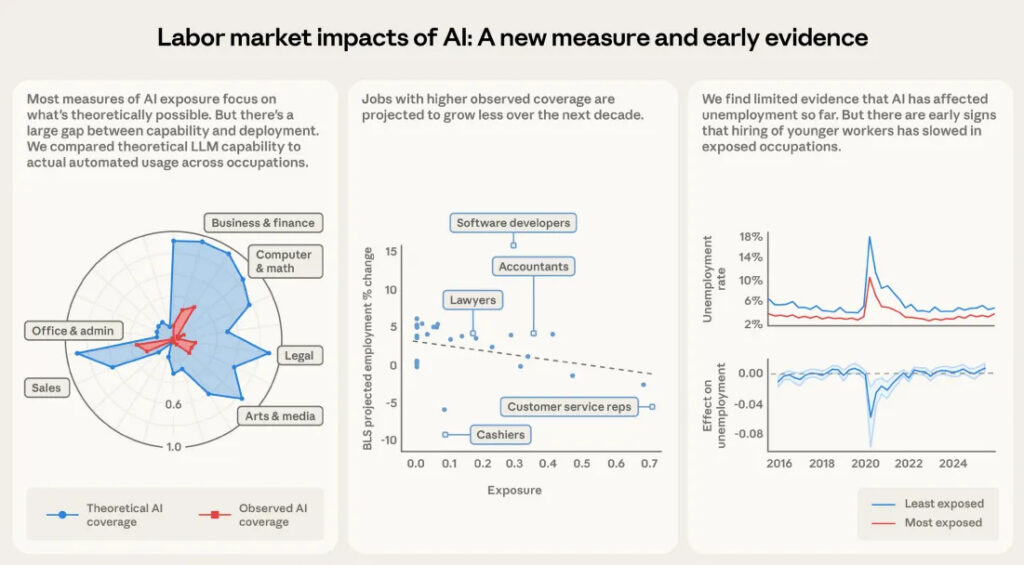
The core finding? Despite two years of rapidly advancing AI capabilities since ChatGPT’s launch, there’s been no measurable spike in unemployment among the workers most exposed to AI automation. Not yet, anyway.
A Better Way to Measure AI’s Job Impact
Past attempts to predict job displacement haven’t aged well. A decade ago, researchers identified a quarter of US jobs as vulnerable to offshoring. Most of those jobs are still here and growing. Industrial robot studies reached completely opposite conclusions about employment effects. Even the government’s own occupational forecasts barely outperform simple trend extrapolation.
Anthropic’s approach is different. Instead of just asking “could AI theoretically do this task?”, they combine three data sources to track what’s actually happening:
Theoretical capability: Task-level assessments from research showing whether an LLM could make a task at least twice as fast.
Real-world usage: Anthropic’s own platform data showing which tasks people are actually automating with Claude in professional settings.
Work context and automation depth: Tasks performed in work settings count more than casual use. Fully automated workflows count double compared to tasks where AI just assists humans.
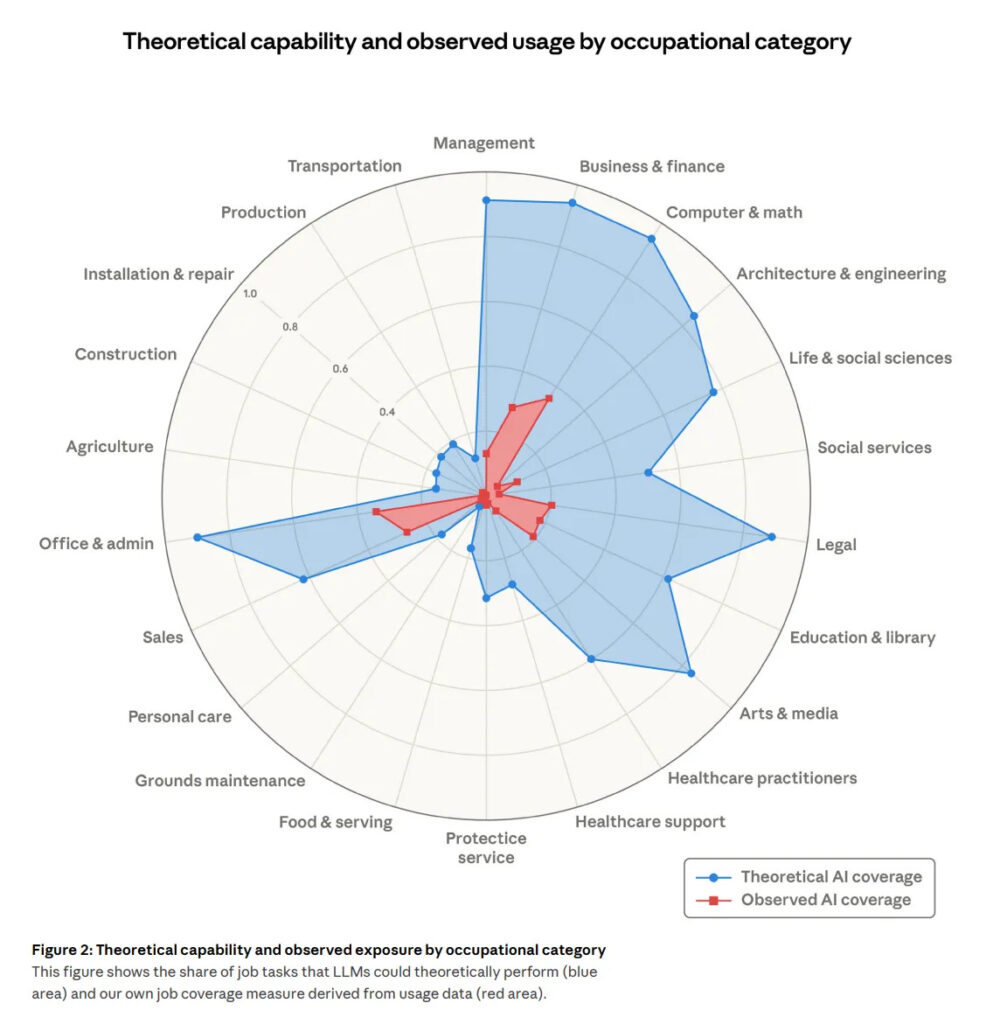
They call this “observed exposure,” and it reveals a striking gap. While AI could theoretically handle 94% of tasks in Computer & Math occupations and 90% of Office & Admin tasks, actual coverage from real-world Claude usage is just 33% for Computer & Math jobs. Theory vastly outpaces reality.
The Most Exposed Jobs
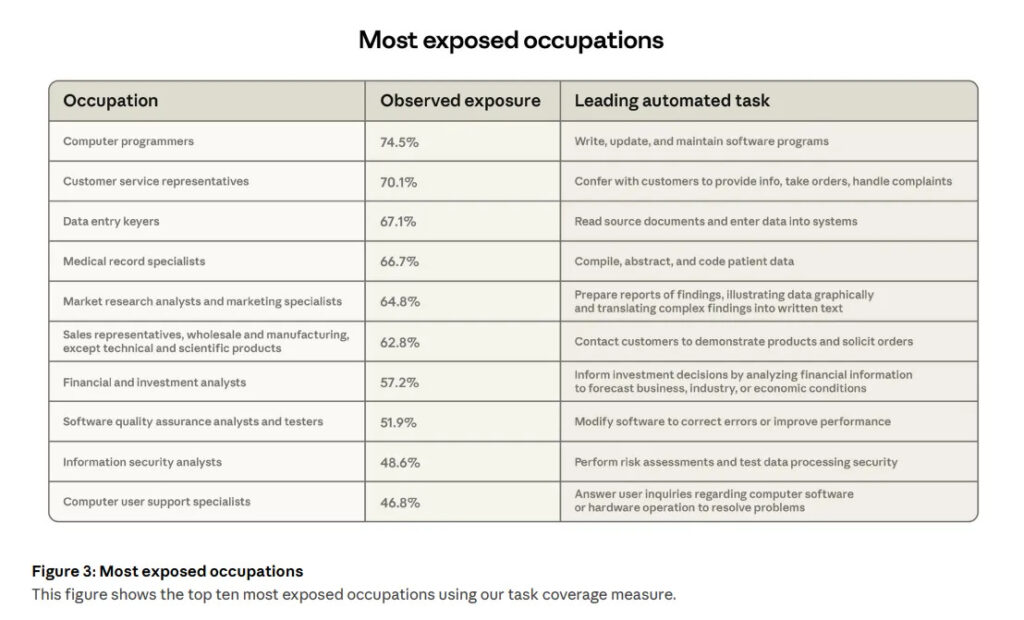
Computer Programmers top the exposure list at 75% coverage, followed by Customer Service Representatives and Data Entry Keyers at 67%. This aligns with what anyone paying attention already knows: coding assistance and customer service automation are where AI deployment is actually happening at scale.
At the bottom? About 30% of workers have zero AI exposure. This includes Cooks, Motorcycle Mechanics, Lifeguards, Bartenders, Dishwashers, and similar roles where physical presence and human interaction remain essential. AI can write code remotely; it can’t flip burgers or fix engines.
The workers caught in the middle are interesting. Those in the top quartile of AI exposure are 16 percentage points more likely to be female, 11 points more likely to be white, almost twice as likely to be Asian, earn 47% more on average, and hold graduate degrees at four times the rate of unexposed workers.
This contradicts the narrative that AI primarily threatens low-wage, low-skill jobs. The most exposed workers are highly educated professionals in office settings, not factory workers or service staff.
What the Data Actually Shows (And Doesn’t Show)
Here’s where it gets interesting. Anthropic tracked unemployment rates for highly exposed workers versus those with zero AI exposure from 2016 through early 2026. The finding: no systematic increase in unemployment for the exposed group since ChatGPT’s release in late 2022.
During COVID, less AI-exposed workers (who tend to have in-person jobs) saw much larger unemployment spikes. Since then, the trends have been remarkably similar between exposed and unexposed groups. The statistical analysis shows a small, statistically insignificant uptick in unemployment for exposed workers, essentially indistinguishable from zero.
But there’s a concerning signal in the data. For workers aged 22 to 25, hiring into highly exposed occupations has slowed notably. Young workers entering the job market are about 14% less likely to start new jobs in AI-exposed occupations compared to 2022, a barely statistically significant but real decrease.
This echoes research from MIT showing a 6 to 16% fall in employment for young workers in exposed occupations, primarily through reduced hiring rather than layoffs. The implication: companies aren’t firing experienced workers, but they’re hiring fewer entry-level employees in roles where AI can handle routine tasks.
For recent graduates entering fields like programming, data entry, or customer service, the job market may be quietly getting harder without showing up in overall unemployment statistics.
Why the Middle East Should Care
The Gulf states have made enormous bets on AI. The UAE and Saudi Arabia are deploying over $20 billion in AI and data center infrastructure. Abu Dhabi is building what will be the world’s largest AI campus outside the US, a 26 square kilometer site housing 5 gigawatts of data center capacity. Qatar committed $4.9 billion to AI initiatives under its Digital Agenda 2030.
These aren’t vanity projects. According to McKinsey, AI could deliver up to $150 billion in value to GCC countries by 2030, roughly 9% of combined GDP. PwC estimates AI will contribute $15.7 trillion to the global economy by 2030, and the Middle East intends to capture a meaningful share.
But here’s the paradox: while Western workers increasingly fear AI-driven job loss, Middle Eastern workers are remarkably optimistic. PwC’s 2025 Workforce Hopes and Fears Survey found that 80% of Middle East employees say AI has improved their productivity, and 87% report higher-quality work. That’s dramatically higher than global averages.
Just two years earlier, in 2023, only 46% of regional respondents expressed optimism about AI. In the UAE, Qatar, and Saudi Arabia, optimism was even lower at 39 to 41%. What changed?
Government direction and rapid deployment created a positive feedback loop. Instead of fearing displacement, 82% of employees say AI makes them more productive. The UAE reached a 97% AI adoption rate across government and key sectors by late 2025, the highest in the world. Rather than viewing AI as a job threat, workers in labor-scarce Gulf economies see it as a tool to fill talent gaps and automate repetitive work, freeing them for higher-value tasks.
This optimism is built on solid economic fundamentals. With 60% of the Middle East population under 30 and massive transformation underway in finance, energy, mobility, and tourism, AI is framed as an enabler of growth rather than a substitute for human labor. Projections suggest AI will drive net job growth in the region, with companies reshaping roles rather than cutting headcount.
But Anthropic’s research injects a note of caution into this optimism.
The Disconnect Between Coverage and Impact
Here’s the critical insight from Anthropic’s work: AI is nowhere near reaching its theoretical capability. Coverage remains a fraction of what’s technically feasible. Even Computer Programmers, the most exposed occupation, are only 75% covered by real-world automated usage. Most jobs show even wider gaps.
This means two things. First, current lack of employment impact doesn’t prove AI won’t displace jobs later. We’re in the early stages of a diffusion process. As capabilities advance, adoption spreads, and deployment deepens, the red area in Anthropic’s charts (actual usage) will grow toward the blue area (theoretical capability).
Second, the US Bureau of Labor Statistics seems to be picking up these signals already. Occupations with higher observed AI exposure are projected to grow more slowly through 2034. For every 10 percentage point increase in AI coverage, BLS growth projections drop by 0.6 percentage points. It’s a slight relationship, but it exists, and notably, it only appears with Anthropic’s observed exposure measure, not with theoretical capability alone.
What happens in the gap between theory and practice matters enormously for workforce planning.
What Middle Eastern Policymakers Should Watch
The GCC’s approach to AI workforce transition differs fundamentally from Western models. Rather than strict AI regulation, the region favors soft guidance and rapid experimentation. The assumption is that AI augments rather than replaces workers, particularly in economies facing genuine talent shortages.
This approach has worked well so far. But Anthropic’s research highlights several areas worth monitoring:
Entry-level hiring in exposed occupations. The 14% drop in job starts for young workers in high-exposure jobs is subtle but real. If the pattern holds, it could create a generation of workers who struggle to enter professions that were previously reliable entry points to the middle class. For Gulf states investing heavily in education, discovering that graduates can’t find entry-level jobs in their fields would be a serious policy failure.
Skills mismatches between education and market needs. According to PwC, 52% of Middle Eastern employees believe they’ll need new skills within three years, yet only one-third feel their organizations provide sufficient development opportunities. The World Economic Forum predicts 39% of skills globally will be disrupted by 2030, a trend even more pronounced in rapidly transforming Gulf economies. If AI eliminates entry-level coding jobs but creates demand for AI-human collaboration skills, education systems need to adapt quickly.
Differential impacts across workforce segments. Anthropic’s data shows that highly exposed workers are disproportionately female and highly educated. In GCC countries working to increase female workforce participation and Emiratization/Saudization of knowledge economy jobs, understanding which roles face AI pressure matters for achieving national workforce goals.
The automation vs. augmentation balance. Current optimism in the Middle East rests on the belief that AI primarily augments work. Anthropic’s methodology specifically tracks automated usage patterns (full weight) versus augmentative use (half weight) because automation poses greater displacement risk. Monitoring how this balance evolves will signal whether current optimism is justified or premature.
Regulatory preparedness for rapid change. The GCC’s light-touch regulatory approach works when change is gradual. But if coverage accelerates or certain sectors experience sudden automation, the region will need mechanisms to support displaced workers, retrain affected populations, and ensure transitions don’t create social friction. Academic research published in late 2025 questioned whether GCC investments in compute infrastructure are matched by equally robust skills development, incentives, and governance.
The China Trade Shock Lesson
Anthropic’s report opens by noting that even in retrospect, the employment effects of major economic disruptions remain debated. Studies on industrial robots reach opposite conclusions. The scale of job losses from the China trade shock is still contested, years after the fact.
The honest assessment is that we often don’t know how technology or trade affects jobs until well after the fact, and even then, the evidence is ambiguous. Anthropic’s framework aims to establish baselines now, before meaningful effects emerge, so future analyses can more reliably identify genuine disruption.
For the Middle East, this humility matters. The region’s current AI optimism is supported by real data: high adoption, productivity gains, quality improvements. But these metrics were measured during a period when AI coverage was still a fraction of theoretical capability and when most implementation was augmentative rather than automated.
As those conditions change, as coverage grows, as automation deepens, the impacts may shift. The lack of employment effects so far doesn’t guarantee continued labor market stability.
What Founders and Workers Should Do
If you’re building a startup in the Middle East, particularly in sectors like customer service, software development, data processing, or financial analysis, Anthropic’s research offers both opportunity and warning.
The opportunity: AI-exposed tasks are where your product can add immediate value. Businesses are actively seeking ways to automate the 33% of Computer & Math tasks currently covered by AI, and they’ll pay for tools that make automation reliable, compliant, and effective. The gap between theoretical capability (94%) and actual coverage (33%) represents your addressable market.
The warning: if your business model depends on hiring large teams to perform tasks that AI can increasingly handle, plan for scenarios where talent costs rise (due to scarcity) while automation pressure grows. The sweet spot is building companies that combine AI automation with human expertise in ways that create more value than either alone.
For workers, especially young professionals entering the job market, the data suggests being strategic about which skills to develop. Entry-level positions in highly exposed occupations may be harder to secure. But the Gulf’s massive infrastructure investments and economic transformation create enormous demand for workers who can combine technical knowledge with AI literacy, cultural understanding, and the kind of judgment that remains stubbornly difficult to automate.
According to regional workforce studies, AI literacy and sustainability fluency are becoming central to employability. The GCC needs workers who can navigate the intersection of ethics, technology, and organizational performance, embedding principled decision-making and ensuring new tools are used responsibly.
The Path Forward
Anthropic’s research introduces a methodology that can track AI’s job market impacts as they develop, not just after the fact. By combining theoretical capability with observed usage data and weighting for automation depth and work context, they’ve created a measure that’s both current and predictive.
The initial findings are reassuring: no systemic unemployment increase for highly exposed workers since late 2022. But the subtle signal in young worker hiring, the correlation between exposure and BLS growth projections, and the vast gap between theoretical capability and actual coverage all suggest that the story is far from over.
For the Middle East, which has embraced AI more enthusiastically than perhaps any other region, the research offers a framework for monitoring what comes next. Current optimism is justified by current data. Whether that optimism proves durable depends on whether governments, employers, and education systems can adapt as quickly as the technology itself.
The Gulf states have made their bet. They’re building the infrastructure, attracting the talent, and deploying the capital. Now comes the harder part: ensuring that the human workforce evolves alongside the AI capabilities being deployed at scale.
Anthropic’s research won’t answer that question definitively. But it provides a systematic way to track progress, identify early warning signs, and separate genuine disruption from background noise. For a region betting its economic future on AI, that clarity could prove invaluable.
Anthropic’s “Labor market impacts of AI: A new measure and early evidence” was published March 5, 2026, and authored by Maxim Massenkoff and Peter McCrory. The research draws on ONET occupational data, Anthropic’s Economic Index usage data, and task-level exposure estimates from Eloundou et al. (2023).*
You may also like
-
Pakistani AI Startup Virtuans Gets Acquired by US Firm AutoAcquire in Seven-Figure Deal
-
Lebanon’s HAQQ Legal AI Raises $3M: Building the Operating System for a $1 Trillion Industry
-
MENA, Pakistan & GCC Tech Mid-Week Update
-
AirLLM: Democratizing Large Language Models on Everyday Hardware
-
Uplift AI’s $3.5M Seed Round Signals New Momentum for Pakistan’s Voice AI Landscape