
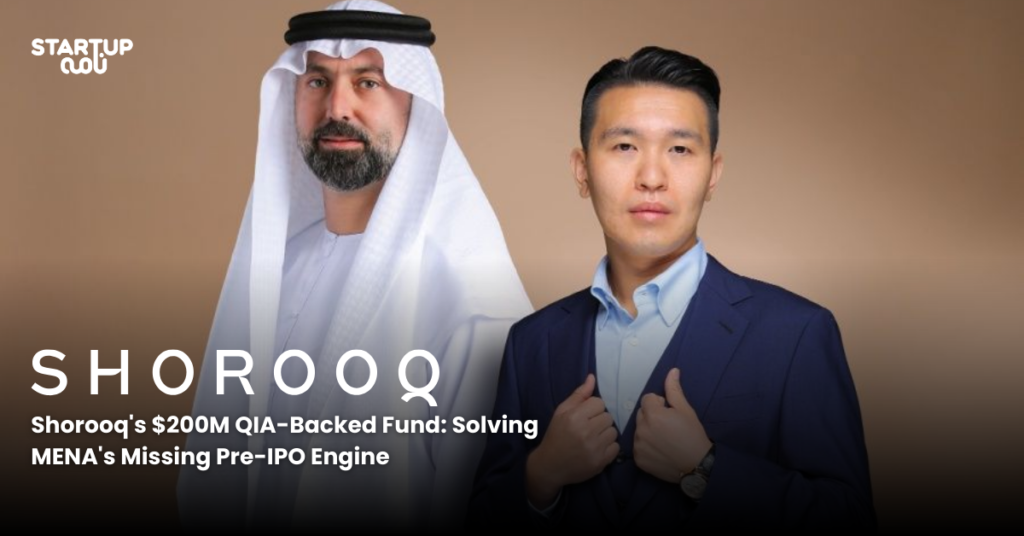
Abu Dhabi-based Shorooq Partners has launched a $200 million late-stage growth fund, marking a strategic move to address what many consider MENA’s most critical infrastructure gap: the missing layer of capital that helps mature startups transition from private scaling to public market leaders.
Announced at Web Summit Qatar on February 2, 2026, the fund, operating under Shorooq’s Qatalyst Series is backed by Qatar Investment Authority (QIA) as anchor investor, alongside other sovereign and institutional partners from across the GCC and Asia. This isn’t just another fund launch; it represents a deliberate attempt to institutionalize what has been conspicuously absent in the regional ecosystem: consistent, patient capital for companies on the cusp of going public.
The $20 Billion Problem
To understand the significance of Shorooq’s move, you need to grasp the magnitude of the late-stage funding gap in MENA. According to research by Saudi Technology Ventures (STV), the region faces a staggering $20 billion funding shortfall for growth-stage companies. While $4.2 billion in VC dry powder exists, that’s nowhere near enough to support the estimated 40 unicorns the region is expected to produce by 2030.
The math is sobering. Based on global benchmarks, each unicorn requires approximately $270 million in total funding. With a projected 40% success rate for growth-stage companies raising larger rounds, MENA needs $25 billion in funding to adequately support its emerging champions. Currently, there aren’t even 10 dedicated late-stage funds operating in the market far from the minimum needed to fill this gap.
The result? A bottleneck that’s choking the ecosystem’s natural progression. Companies that successfully navigate early-stage funding and achieve product-market fit often find themselves stuck when it’s time to scale for regional dominance or prepare for public markets. International investors, meanwhile, demand proven track records and successful exits, track records that can’t be built without the capital to get companies to IPO in the first place.
It’s a classic chicken-and-egg problem, and it’s precisely what Shorooq’s new fund aims to crack.
Why Late-Stage Funding Matters More Than You Think
Growth-stage companies need 10-20 times more capital than their early-stage counterparts. This isn’t excess or inefficiency, it’s the reality of scaling. At this stage, the business model is proven, and the focus shifts from experimentation to execution. Companies need capital to hire experienced C-level executives, expand geographically beyond their home markets, build working capital reserves, establish M&A strategies, and professionalize operations to meet public market standards.
The irony is that while the capital requirements are higher, the risk profile is significantly lower compared to early-stage startups. This creates an attractive opportunity for investors to deploy substantial capital into lower-risk companies that can deliver strong returns in relatively short timeframes as they move toward exits.
Yet in MENA, this opportunity has been largely underserved. Data from 2025 tells the story clearly. While the region saw significant funding activity overall with September 2025 hitting a record $3.5 billion across 74 deals, late-stage rounds remained episodic rather than consistent. When late-stage investments did occur, they were concentrated around a handful of megadeals rather than distributed across a healthy pipeline of maturing companies.
Even more telling: November 2025 saw zero late-stage rounds recorded, as investors adopted cautious postures amid valuation resets. The message was clear: late-stage funding in MENA wasn’t reliable infrastructure, it was opportunistic capital that appeared when conditions were perfect and vanished when uncertainty crept in.
Shorooq’s Full-Stack Evolution
Shorooq’s launch of the Qatalyst Series represents the completion of what founding partner Mahmoud Adi describes as the firm’s evolution into a “full-stack investment platform.” Founded in 2017 by Adi and Shane Shin, Shorooq started as an early-stage venture capital firm. Over the past eight years, it has systematically built out capabilities across the entire capital stack.
The firm now operates:
- Early-stage venture capital vehicles targeting seed to Series A startups with check sizes of $1-8 million across the GCC, Egypt, and Pakistan
- Private credit funds providing non-dilutive financing to mature companies (including a $100 million fund that reached first close in 2024)
- Specialized strategies including a $100 million global AI innovation fund launched in partnership with Abu Dhabi-based Presight in September 2025
- And now, late-stage growth capital through the $200 million Qatalyst Series
This comprehensive approach allows Shorooq to support founders from first check through IPO, a rare capability in any market, and particularly valuable in MENA where different growth stages often require navigating entirely different investor networks.
“This Fund represents a natural evolution of our platform and how we partner with founders across their full growth journey,” Adi explained at the fund’s launch. “With our venture capital vehicles, credit strategies, and now a dedicated late-stage growth fund, we are uniquely positioned to support companies across the entire venture capital stack, from early conviction to late-stage scale and public market readiness.”
The QIA backing adds another dimension. Qatar’s sovereign wealth fund has been systematically building its venture ecosystem presence, recently expanding its Fund of Funds program to $3 billion and attracting top-tier global VCs like A16Z and Blockchain Capital to the region. QIA’s involvement in Shorooq’s fund reinforces the sovereign’s commitment to building genuine infrastructure rather than just deploying opportunistic capital.
Who Gets the Capital?
The Qatalyst Series has a clear target profile: companies with proven scale, strong unit economics, sustainable fundamentals, and clear pathways to exit, particularly through IPO routes. Adi told Semafor that over the next two to three years, the strongest opportunities will be among companies that have already validated their business models but need patient, structured capital to professionalize and scale ahead of public listings.
Sector focus areas include:
- Fintech infrastructure (payment processors, embedded finance, digital banking rails)
- Enterprise software and SaaS (particularly mission-critical B2B platforms)
- AI and data analytics (solutions with clear commercial applications)
- Regulated and mission-critical businesses (healthcare tech, logistics, education tech)
Geographically, the fund will invest across MENA and Asia, though the GCC and broader Middle East will likely see the bulk of deployment given market maturity and IPO readiness.
Shorooq’s existing portfolio offers hints about the kinds of companies that might benefit from late-stage growth capital.
The firm has backed regional champions like:
- Tamara – Saudi Arabia’s first BNPL platform and a fintech unicorn
- Pure Harvest Smart Farms – Sustainable agriculture technology producing fresh crops in desert climates (co-founded by Adi himself)
- NymCard – The region’s first digital issuer processor enabling businesses to issue payment cards
- Lean Technologies – Open banking and financial data infrastructure
- Sarwa – MENA’s leading robo-advisor wealth management platform
- TruKKer – Middle East’s largest tech-driven logistics aggregator
- Lendo – Saudi Arabia’s leading P2P SME lending and invoice factoring platform
- Mozn – AI-powered enterprise solutions for data-driven decision making
Many of these companies have already raised Series A or later rounds and are exactly the kind of proven, scaling businesses that need growth capital to reach the next level. Some, like Tamara and TruKKer, have already filed or announced plans to pursue IPOs—making them prime examples of the companies Shorooq’s late-stage fund is designed to support.
The IPO Drought and What It Means
Only four MENA startups have successfully gone public to date, a remarkably low number for an ecosystem that has now invested over $9 billion in 2,000+ startups since 2018. Companies like Tabby, Floward, TruKKer, and Unifonic have unveiled IPO plans, but actualizing those plans requires the kind of pre-IPO financing that strengthens governance, scales operations regionally, and builds the financial track records that public market investors demand.
The obstacles to IPO in MENA are well-documented: relatively unsophisticated public markets (though this is changing), complex regulatory environments that vary significantly by country, public investors unfamiliar with tech business models, and the governance structures required for listed companies. However, Saudi Arabia’s Nomu parallel exchange has shown promise, with delivery platform Jahez’s successful listing paving a path others might follow.
What’s been missing is the capital infrastructure to help companies navigate the 18-24 month pre-IPO journey. That’s precisely the gap Shorooq’s fund addresses. By providing long-duration capital with patient timelines, the fund gives companies room to build IPO-grade financials, implement proper governance frameworks, expand into multiple markets to demonstrate regional leadership, and achieve the scale that makes public listings attractive to institutional investors.
Why 2026 Is the Right Time
Several macro factors make Shorooq’s timing particularly strategic:
Sovereign liquidity is concentrated. GCC sovereign wealth funds are sitting on trillions in assets and have explicitly prioritized technology and knowledge economy investments. Saudi Arabia’s Public Investment Fund, Abu Dhabi’s ADQ and Mubadala, and Qatar’s QIA are all actively deploying into the venture ecosystem. This creates both direct co-investment opportunities and downstream demand for the kinds of scaled, regional companies that late-stage capital produces.
A cohort of scale-ups has matured. The early-stage boom of 2018-2021 has now produced a meaningful pipeline of companies that have achieved product-market fit, established revenue models, and are ready for the next phase. These companies are entering their growth-stage years now, creating immediate deployment opportunities.
Markets are disciplined. The funding environment of 2025 demonstrated that capital is increasingly flowing toward proven business models with defensible economics. B2B companies raised 70% of H1 2025 funding because they offered clearer monetization and revenue visibility. This flight to quality creates an ideal environment for growth-stage investing, where risk is lower and returns are tied to execution rather than speculation.
Debt has shown the way. The rise of debt financing in MENA, January 2025 saw $768 million of the $863 million raised come through debt demonstrates that mature startups have the revenue and assets to support structured financing. This de-risks equity investments by proving cash flow sustainability.
Exit pathways are opening. While still limited, exit activity increased from 2018-2022 with 190 acquisitions recorded. The average journey from startup to exit in MENA is eight years—meaning companies founded in 2017-2018 are now hitting that window. More exits create the track record that attracts institutional capital, which in turn funds more growth-stage companies, creating a virtuous cycle.
What This Means for Founders
If you’re running a Series A or Series B company in MENA with proven metrics and regional ambitions, Shorooq’s fund changes your calculus in several important ways:
Access to patient capital. Late-stage growth rounds often require 12-18 month cycles to raise from international investors who don’t know your market. A dedicated regional fund with sovereign backing accelerates this timeline and reduces the need to constantly educate investors about MENA fundamentals.
Full-stack partnership. Companies in Shorooq’s early-stage portfolio now have a clear path to continued support as they scale. You’re not building toward a handoff to a new investor—you’re deepening a relationship with a partner who has already committed to your success and understands your business.
De-risked fundraising. Knowing that growth capital exists regionally makes seed and Series A rounds less risky. Early-stage investors can point to a viable pathway for their portfolio companies to raise growth rounds without depending solely on international capital that may or may not materialize.
IPO pathway clarity. The fund’s explicit focus on pre-IPO companies creates a clear milestone to work toward. If you can demonstrate the scale, governance, and fundamentals Shorooq is looking for, you have a potential partner for the IPO journey rather than having to cobble together financing from multiple sources.
Competitive benchmarking. Shorooq’s investment criteria will effectively set standards for what “late-stage ready” means in MENA. Companies can use this framework to understand what metrics and capabilities they need to develop to access growth capital.
The Broader Ecosystem Play
Individual fund launches matter, but Shorooq’s move should be understood in the context of broader ecosystem development. The firm has been systematically building infrastructure that didn’t previously exist in MENA.
In 2023, Shorooq closed its second MENA and Pakistan venture fund at $150 million, creating a dedicated early-stage vehicle for the region. In 2024, it launched its $100 million second private credit fund in partnership with Korean firm IMM Investment Global, specifically targeting companies in manufacturing, industrials, financing, and software services that need non-dilutive capital. In 2025, it partnered with Presight to launch a $100 million AI fund providing portfolio companies with access to cloud infrastructure and GPU compute.
Each of these moves addresses a specific gap in the capital stack. Together, they create a comprehensive platform that mirrors the kind of full-spectrum support available in mature ecosystems like Silicon Valley or Singapore, but adapted for MENA’s unique characteristics.
The QIA partnership adds institutional validation and creates a replicable model. If Qatar’s sovereign wealth backing proves successful in generating returns and building IPO-ready companies, other GCC sovereigns will likely launch similar vehicles. The goal isn’t for Shorooq to be the only late-stage fund in the region—it’s for Shorooq to prove the model so that others follow.
“We expect the opportunity set to be strongest in companies that have already proven their economics but now need patient, structured capital to scale and professionalize ahead of public markets,” Adi noted. The emphasis on “patient, structured capital” is telling. This isn’t about quick flips or opportunistic bets, it’s about building enduring businesses that can become publicly traded champions.
Challenges Ahead
For all its promise, late-stage investing in MENA faces genuine challenges that even $200 million in dedicated capital can’t fully solve.
The track record problem persists. Institutional investors evaluate fund managers based on DPI (distributions to paid-in capital) and proven exits. MENA growth-stage funds are still building those track records because the ecosystem is young. Until several successful IPOs or major acquisitions occur, institutional capital will remain somewhat skeptical.
Valuation alignment remains tricky. Late-stage companies in MENA often have revenue multiples that don’t align with comparable companies in more mature markets. Bridging this valuation gap while maintaining attractive returns for LPs requires careful deal structuring.
Exit timelines are uncertain. Even with dedicated capital to reach IPO-readiness, the actual timing of public listings depends on market conditions, regulatory approvals, and investor appetite—factors largely outside any single fund’s control. If exits take longer than expected, fund performance suffers.
Regional fragmentation complicates scaling. MENA isn’t a single market—it’s a collection of countries with different regulations, languages, currencies, and consumer preferences. Achieving the regional scale that makes IPOs viable often requires navigating significant complexity.
Competition from international capital. As MENA companies mature and de-risk, they become attractive to international growth funds with larger checkbooks and global networks. Keeping these companies in regional orbits requires more than just capital, it requires genuine value-add.
Looking Forward
Shorooq’s announcement of a Doha office as part of this expansion signals that the fund isn’t just about deploying capital, it’s about building presence and relationships across GCC markets. Qatar’s emergence as a startup hub, supported by QIA’s $3 billion Fund of Funds and initiatives like Web Summit Qatar, creates opportunities for Shorooq to source deals and support portfolio companies in a fast-developing market.
For the broader MENA ecosystem, the fund’s success or failure will serve as a critical test case. If Shorooq can successfully deploy $200 million into late-stage companies that achieve strong exits—particularly through IPOs—it will demonstrate that the model works. Other institutional investors will follow, catalyzing the estimated $20 billion in growth-stage capital the region needs.
If the fund struggles to find sufficient high-quality deals or if exits take longer than expected, it may reinforce skepticism about late-stage investing in the region and slow the development of this critical infrastructure layer.
The stakes are high, but so is the potential. MENA has spent the past five years building a foundation of early-stage activity. Now comes the test of whether that foundation can support the weight of genuine scale-ups and public market leaders.
What Founders Should Do Now
If you’re building a startup in MENA, particularly in fintech, software, or infrastructure sectors, here’s what Shorooq’s fund means for your planning:
Build for scale from day one. Late-stage investors aren’t looking for interesting experiments—they’re looking for proven business models ready to dominate markets. Focus on unit economics, retention metrics, and demonstrable paths to regional leadership.
Strengthen governance early. Don’t wait until Series B to implement board structures, financial controls, and compliance frameworks. Companies that have these in place are dramatically more attractive for growth capital.
Think regionally, not locally. Single-market dominance won’t cut it for late-stage investors. Build expansion plans that demonstrate how you’ll achieve meaningful scale across multiple GCC or MENA markets.
Know your metrics cold. Growth investors conduct rigorous due diligence focused on LTV/CAC ratios, net revenue retention, gross margins, and burn multiples. If you can’t articulate these clearly, you’re not ready for late-stage capital.
Build relationships early. Don’t wait until you need growth capital to start conversations with late-stage investors. Build relationships when you’re at Series A, so when you’re ready for growth rounds, you’re already a known quantity.
The institutionalization of MENA’s late-stage funding infrastructure has begun. Shorooq’s $200 million Qatalyst Series, backed by QIA and positioned explicitly to build the region’s pre-IPO engine, represents a meaningful step toward closing the $20 billion gap that has constrained the ecosystem’s maturation.
Whether it succeeds in creating a repeatable pathway from private scaling to public market leadership remains to be seen. But for the first time, that pathway has dedicated infrastructure, institutional backing, and patient capital behind it.
For MENA’s founders and the region’s ambitions to become a genuine innovation hub, that’s a development worth watching closely.
Shorooq Partners is a UAE-based multi-strategy investment firm founded in 2017, with total assets under management exceeding $1 billion across venture capital, private credit, and growth equity strategies.
You may also like
-
MENA, Pakistan & GCC Tech Roundup | Week of July 14-22, 2026
-
Lebanon’s HAQQ Legal AI Raises $3M: Building the Operating System for a $1 Trillion Industry
-
Qureos Secures $5 Million Seed Round to Transform Hiring with AI Across MENA and Beyond
-
Uplift AI’s $3.5M Seed Round Signals New Momentum for Pakistan’s Voice AI Landscape
-
Epic Angels Backs Neem to Power Pakistan’s Shift from Cash to Digital Payments