
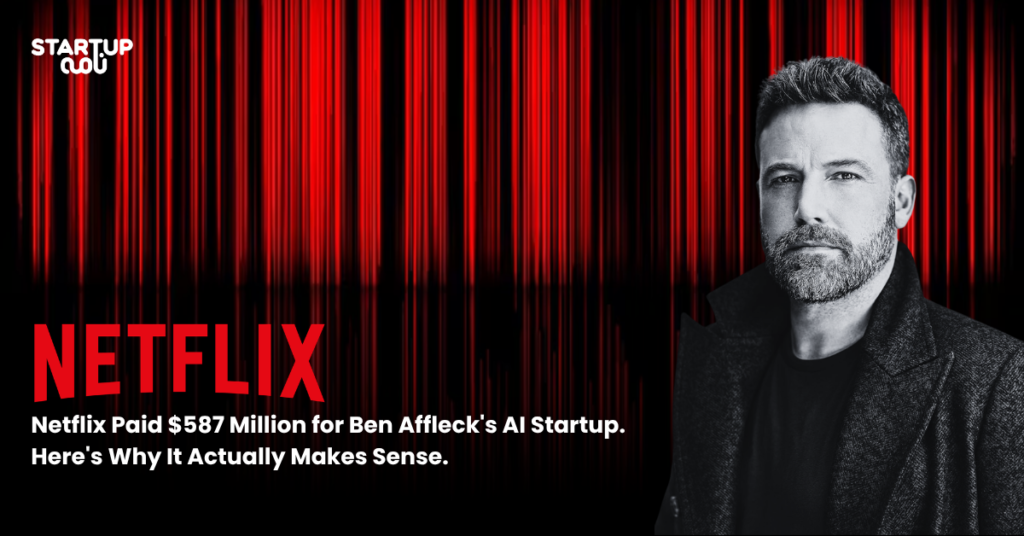
When Netflix quietly acquired a little-known AI filmmaking startup called InterPositive back in March 2026, most people focused on the celebrity angle: an Oscar-winning actor and director building a tech company in stealth for four years. Interesting, sure. But the real story only became clear this week when Netflix’s quarterly SEC filing revealed what it actually paid for the deal: $587 million in cash.
That’s not celebrity vanity money. That’s a strategic infrastructure bet, and the numbers coming out of Netflix’s Q2 2026 earnings explain exactly why.
What InterPositive Actually Built
Before the valuation makes sense, you need to understand what InterPositive is, and more importantly, what it isn’t.
“It’s not about text-prompting or generating something from nothing,” Affleck explained when the acquisition was announced. “AI, people mostly think of it as making something from nothing: ‘I’m gonna type something into a computer and it’s gonna give me a movie.’ That’s not what this is.”
InterPositive was founded by Affleck in 2022 with a focus on developing artificial intelligence tools designed to assist filmmakers throughout the production process. Rather than replacing creative professionals, the company aimed to improve visual effects workflows while preserving the artistic decisions made by writers, directors, cinematographers and editors.
The InterPositive system builds an AI model based on an existing production’s dailies, then lets a filmmaker introduce that model into the postproduction process to provide the ability to do things like mix and color, relight shots, and add visual effects. In other words, the AI learns the specific visual language of your film, then helps you fix, enhance, and extend footage in ways that remain consistent with your original creative intent.
According to Affleck, InterPositive developed proprietary datasets captured on controlled soundstages to train models capable of understanding visual continuity and cinematic language. The technology was designed to solve production challenges including missing shots, background replacements and lighting inconsistencies while maintaining editorial consistency.
This distinction matters enormously. Hollywood’s fights with AI have centered on generative tools that create content from nothing, threatening writers, actors, and below-the-line crews. InterPositive sits in a different category: a tool that amplifies what human filmmakers have already created, rather than replacing the creation itself.
Netflix said it saw Affleck’s InterPositive as providing a unique set of AI tools that “keeps filmmakers at the center of the process.” Netflix will offer access to InterPositive’s tech to its creative partners and does not have plans to sell it commercially in the marketplace.
The Stealth Years
The backstory here is worth dwelling on. Affleck said the idea for InterPositive emerged after he closely observed early uses of artificial intelligence in film production around 2022. He said that many emerging AI systems were not built with filmmakers’ real-world workflows in mind. As a result, the company began designing tools tailored to the technical and creative realities of a film set, including camera behaviour and lighting changes.
Affleck’s L.A.-based company, which has been in stealth mode since he founded it in 2022, does not produce generative AI videos à la OpenAI’s Sora. For four years, a 16-person team of engineers, researchers, and creatives quietly built technology in a domain where most AI companies were chasing flashy text-to-video demos. InterPositive went the other direction: deep, production-specific tooling built on proprietary datasets from real film sets, designed to solve the unglamorous but expensive problems that filmmakers actually face.
That focus is almost certainly why Netflix paid $587 million for 16 people. The technology is purpose-built for professional film production in a way that general-purpose AI tools simply aren’t, and Netflix can’t easily replicate it internally.
Why Netflix Needed This
Netflix’s content budget tells a story of relentless escalation. Spending grew from $16.2 billion in 2024 to roughly $17-18 billion in 2025, and is now projected to hit $20 billion in 2026. At that scale, even modest efficiency gains translate into hundreds of millions of dollars.
Netflix co-CEO Ted Sarandos said generative AI workflows have been used in roughly 300 Netflix titles, concentrated in post-production, enabling the streamer to make “higher quality output more quickly and efficiently.”
The flagship example is striking. Sarandos cited The American Experiment as a breakthrough, with 17 minutes of AI-enhanced footage produced twice as fast and at half the cost. A Tom Hanks-backed documentary that would have required expensive historical reenactments, elaborate sets, and weeks of additional shooting instead used AI to generate footage that cleared Netflix’s bar for broadcast quality.
The disclosure marks a dramatic acceleration from July 2025, when Netflix first confirmed the use of generative AI in a single production, the Argentine sci-fi series “The Eternauts.” By Q2 2026, co-CEO Ted Sarandos told investors that the technology is no longer an experiment but a production infrastructure, with the bulk of the work concentrated in post-production tasks like visual effects, relighting, and complex crowd simulation.
Three specific productions demonstrate the range: Glory, an Indian crime suspense series; Brasil 70: A Saga do Tri, a Brazilian documentary; and The American Experiment in the US. Different genres, different countries, different production contexts. All using AI in post-production to achieve results that would have been cost-prohibitive using traditional methods.
As part of the acquisition, the entire InterPositive team of 16 engineers, researchers and creatives joined Netflix, while Affleck himself took on a new role as senior adviser to continue developing filmmaking tools. Netflix is also consolidating its virtual effects and production capabilities under the Eyeline studio banner, suggesting InterPositive sits within a broader infrastructure buildout rather than as a standalone experiment.
The $587 Million Question
Bloomberg reported that Netflix could pay up to $600 million total if InterPositive meets “certain performance targets,” with the $587 million representing the upfront cash component. At that price, this ranks among Netflix’s biggest ever acquisitions, and it raises an obvious question: how does a 16-person startup command that valuation?
A few factors explain the premium.
First, scarcity. The company designed tools to cater to the technical and creative realities of a film set, including camera behaviour and lighting changes, resulting in proprietary datasets and models that would take years to replicate. Netflix couldn’t just build this internally; it would require years of production-specific data collection and model training that InterPositive had already done.
Second, timing. Netflix is spending $20 billion on content in 2026. If InterPositive’s tools can reduce post-production costs by even 10 to 15% across a meaningful portion of that slate, the return on a $587 million investment is obvious. The American Experiment example, producing 17 minutes of AI-enhanced footage at half the cost of traditional methods, points toward exactly that kind of savings at scale.
Third, exclusivity. Netflix will offer access to InterPositive’s tech to its creative partners and does not have plans to sell it commercially in the marketplace. By keeping the technology proprietary, Netflix gains a production efficiency advantage that competitors on a $15 billion or $16 billion content budget can’t easily replicate.
Fourth, the performance structure. With up to $600 million contingent on hitting targets, Netflix has aligned incentives perfectly. If InterPositive’s technology delivers on its promise at scale across hundreds of productions, the extra $13 million in performance payments is trivial compared to the savings generated.
Hollywood’s Complicated Feelings
The announcement has landed in an industry still processing the implications of the 2023 Hollywood strikes, where AI protections for writers and actors were among the central demands.
Filmmaker Guillermo del Toro, who adapted Mary Shelley’s Frankenstein for Netflix, said he’d “rather die” than use generative AI. That sentiment reflects genuine fear within the creative community that AI efficiency gains ultimately translate into fewer jobs for writers, directors, and below-the-line crew members who have historically been essential to film production.
Netflix executives have been careful with their framing. Co-CEO Ted Sarandos was careful to note that “AI will give creatives better tools to bring their visions to life” and said “movies are being made by people who make movies.” He addressed the labor concerns directly, insisting that “great stories require great artists, and AI doesn’t change that,” and said any cost savings generated by AI are more likely to be reinvested in production quality.
The framing around InterPositive specifically leans heavily into this argument. Affleck explained that his goal had always been to protect human creativity while embracing technological innovation. He said filmmaking has continually evolved through advances such as digital cameras, motion capture and virtual production, adding that artificial intelligence should become another tool that supports artists rather than replacing them.
Whether that framing holds up as AI penetration across Netflix’s production slate deepens from 300 titles today toward potentially everything on the platform is a question the industry is watching carefully.
What This Means for AI Startups and Founders
For founders building in the AI space, the InterPositive acquisition carries several lessons worth internalizing.
Vertical depth beats horizontal breadth. InterPositive didn’t try to build general-purpose AI for every industry. It spent four years building production-specific tools for a single domain, collecting proprietary data from real film sets that no one else had. That depth created defensibility that horizontal AI platforms can’t easily replicate, even with vastly more resources.
Proprietary data is the real moat. InterPositive developed proprietary datasets captured on controlled soundstages to train models capable of understanding visual continuity and cinematic language. The AI model is only as good as the data it’s trained on. For film production, that data had to come from actual productions, not scraped from the internet. Building that dataset was the hard part, and it became the core asset.
Stealth worked here. Four years in stealth mode let InterPositive develop technology without competitive pressure or investor timelines pushing toward premature launches. For deep tech building in complex domains, that runway created space for genuine innovation that faster-moving competitors couldn’t match.
The “augmentation not replacement” framing has real business value. Positioning AI as a tool that enhances human creativity rather than substituting for it isn’t just ethical positioning. It directly addresses the primary objection that buyers, in this case creative professionals at Netflix and its partner studios, have to adopting AI tools. InterPositive’s technology won adoption partly because it was genuinely designed around filmmakers’ workflows, not retrofitted to appear that way.
Exits happen through strategic fit, not just financial metrics. Netflix didn’t pay $587 million because InterPositive had impressive ARR. It paid that amount because the technology fit precisely into a strategic imperative around content costs at a moment when the company is spending $20 billion annually. Identifying and building toward those strategic fit scenarios is a more reliable path to significant exits than chasing scale metrics.
The Broader Picture: AI Eating Entertainment
InterPositive sits within a much larger wave of AI deployment across the entertainment industry.
Netflix has begun using generative AI video tools from startup Runway AI to accelerate production and reduce visual effects costs in original content. Runway, backed by $545 million in funding and valued at over $3 billion, has also attracted Lionsgate, which inked a deal to train an AI model using its library of proprietary content for future film applications.
Amazon Prime Video, Disney+, and Apple TV+ are all exploring similar technologies, driven by the same pressure to manage content budgets while maintaining or improving production quality. The efficiency gains Netflix is demonstrating, particularly the American Experiment example of producing footage at half the cost, create competitive pressure for every major streamer to adopt similar tooling.
For the regional media landscape, this trend has direct implications. Arabic-language content production, Bollywood, Turkish drama, and the Egyptian film industry are all significant content markets served by global streaming platforms. As AI tools that were previously only accessible to Hollywood studios become available through platforms like Netflix, production capabilities that once required large budgets become accessible to a broader range of creators.
Netflix’s commitment to keeping InterPositive’s technology proprietary rather than selling it commercially limits its direct availability for now. But the competitive dynamics will push other platforms to either build or acquire similar capabilities, eventually spreading these tools more broadly across the production ecosystem.
Final Thoughts
The $587 million price tag on a 16-person startup gets attention because of the celebrity founder angle. But the more interesting story is what it reveals about where Netflix is heading and what it’s willing to pay to get there.
Netflix has applied generative AI tools across approximately 300 different titles, suggesting this is already baked into the production pipeline rather than treated as a novelty. InterPositive isn’t an experiment. It’s infrastructure for a $20 billion content machine trying to get more output from every dollar spent.
For the AI startup ecosystem globally, and for MENA founders in particular who are building vertical AI solutions in traditionally analog industries, the acquisition is a case study worth studying. Deep domain expertise, proprietary training data, production-specific tooling, and a clear strategic fit with a well-capitalized buyer created a $587 million outcome from a 16-person team operating in stealth for four years.
The technology doesn’t generate movies from prompts. It helps human filmmakers make better movies more efficiently. In an industry terrified of AI replacing artists, that positioning turned out to be exactly right.
Netflix’s acquisition of InterPositive was completed in March 2026 for $587 million in cash, as disclosed in the company’s Q2 2026 SEC filing. Ben Affleck serves as senior advisor to Netflix following the transaction. The InterPositive team of 16 engineers, researchers, and creatives joined Netflix as part of the deal.
You may also like
-
OpenAI’s AI Models Broke Out of Their Cage and Hacked Hugging Face. Here’s What Actually Happened.
-
Cloudflare Just Gave Every AI Agent Its Own Computer. Here’s Why That’s a Big Deal.
-
AI Shopping Startup Phia, Co-Founded by Phoebe Gates, Faces Scrutiny Over Affiliate Tracking Practices
-
Wikipedia’s AI Writing Guide Is the Best Prompt Engineering Resource Nobody’s Talking About
-
Anthropic’s New AI Jobs Report: Why the Middle East Should Pay Attention